Dr. Yolanda Pierce expresses her call to welcome those who come to the communion table:
There is no more sacred ritual I perform within the church context than serving communion. It is a duty I do not take lightly. I relish the opportunity to preside over the table and invite others into a moment of remembrance and reflection. Whether in the most modest of sanctuaries or in the grandest of buildings, standing before the people with unleavened bread and a cup of wine (or grape juice, as in my own tradition) is a humbling act….
When I stand behind the table, calling the gathered community to remembrance, I call forth all their sacred memories: those connected to the biblical text and those that emerge from their own lives. In that divine moment and in this one, I take seriously the exhortation in 2 Peter 1:13: “As long as I live in the tent of this body,” I will call the people to remembrance….
We do this in remembrance of the Holy One, who was and is and is to come…. In remembrance of the warriors for justice, the table turners, and the freedom riders. Those prophets who stood outside the gates of the city and declared the Word of the Lord. Those poets who penned indictments against inhumanity and degradation.
In remembrance of those who have experienced justice delayed and justice denied. Those whose sadness has yet to turn to joy, and those whose weeping has endured for more than one night…. We are all welcome at this table, whether with visible wounds or unblemished flesh, in the radical belief that only God’s justice quenches our thirst, heals our spirits, and renews our hearts. [1]
Theologian M. Shawn Copeland describes how the Eucharist calls us to solidarity with those who suffer:
Eucharist is the heart of Christian community. We know in our bodies that eating the bread and drinking the wine involve something much deeper and far more extensive than consuming elements of the ritual meal…. We [all] strive to become what we have received and to do what we are being made….
Eucharistic solidarity orients us to the cross of the lynched Jesus of Nazareth, where we grasp the enormity of suffering, affliction, and oppression as well as apprehend our complicity in the suffering, affliction, and oppression of others.… Eucharistic solidarity teaches us to imagine, to hope for, and to create new possibilities. Because that solidarity enfolds us, rather than dismiss “others,” we act in love; rather than refuse “others,” we respond in acts of self-sacrifice—committing ourselves to the long labor of creation, to the enfleshment of freedom….
At the table that Jesus prepares, all may assemble: In his body we are made anew, a community of faith—the living and the dead. In our presence, the Son of Man gathers up the remnants of our memories, the broken fragments of our histories, [and] judges, blesses, and transforms them. His Eucharistic banquet re-orders us, re-members us, restores us, and makes us one. [2]
References:
[1] Yolanda Pierce, The Wounds Are the Witness: Black Faith Weaving Memory into Justice and Healing (Broadleaf, 2025), 5, 6–8.
[2] M. Shawn Copeland, Enfleshing Freedom: Body, Race, and Being, 2nd ed. (Fortress Press, 2023), 132, 133, 134.
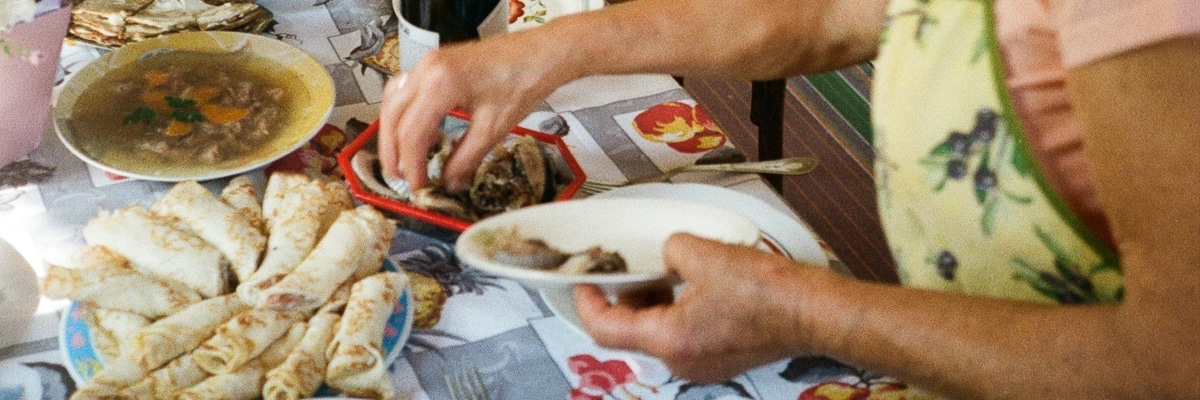
Image credit and inspiration: Anastasia Chervinska, untitled (detail), 2022, photo, Unsplash. Click here to enlarge image. Abundance is a table always set, where the meal awaits with quiet grace and there is always enough for all who arrive.


Story from Our Community:
For the first time in my 81 years, I am starting a small vegetable garden around my house in pots and other containers. I have enjoyed attending to these small plants each day, so much so, that I have been inspired to write a series of inner and outer dialogues about the parables of Jesus. As I write, I look up from my laptop and see the very things being illustrated—nature, the sower, the vineyard, the mustard seed, the wheat and the weeds, the way plants grow. It feels ordained!
—Peter V.