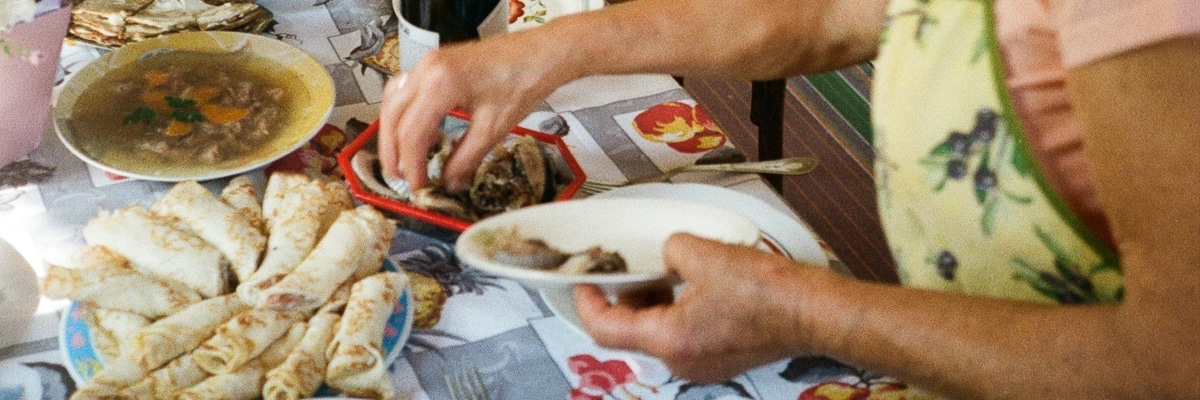
The first meals Jesus shared with his community included bread and fish, while a meal of bread and wine became the official meal of the church. Father Richard explores the importance of each:
The tradition of table fellowship shows up in many places in the Christian Scriptures—for example, the several loaves and fishes accounts in the Gospels (Matthew 14:13–21, 15:32–39; Mark 6:30–44, 8:1–10; Luke 9:10–17; John 6:1–13). Scholars say now that even while Jesus was still alive, there seemed to be two traditions of open table fellowship: one of bread and wine, the other of bread and fish. The bread and wine finally won out—that meal is what we call the Mass today in the Roman Catholic church.
But the bread and fish stories also point to an open table fellowship tradition. The exciting thing about these stories is that they emphasize surplus and outside guests. At the end of each event, there are seven or twelve baskets left over. That surplus seems to be a point of this form of table fellowship. It’s a type of meal we’d call a potluck supper today. Apparently, Jesus invited everybody to bring their food together and there was plenty for all the poor and then some.
It’s unfortunate that we lost the bread and fish ritual meal, because the bread and wine ritual meal didn’t emphasize this idea of surplus: real food that actually fed the poor. The bread and wine tradition lent itself more to purity codes, insider/outsider dynamics, and ritualization. The bread and fish tradition, if retained, might have contributed to issues of justice, community, and social reordering. We see this after the resurrection. In John 21:1–14, the apostles are out on the lake. They see Jesus on the shore, cooking fish at a charcoal fire. He invites them to come share bread and fish.
If we remember what happened after Jesus’ arrest, we see the significance of this charcoal fire. The only other charcoal fire in the Gospels is where Peter stood when he betrayed Jesus (John 18:18). Jesus invites him now to another charcoal fire, where they share the bread and the fish. He says, in effect, “Peter, it’s okay. Forget it.” At this second charcoal fire the risen Jesus initiates table fellowship with Peter, who just a few days before rejected, betrayed, and abandoned him in his hour of need. It seems the bread and fish meal also had a healing, reconciling significance. What a shame we have lost this.
It’s very likely that the Last Supper was a Passover meal of open table fellowship—the final one of many among Jesus and his closest followers—that evolved into a ritualized offering of bread and wine. The disciples had come to understand it as a way of gathering, as the way to define their reality and their relationship to one another. It became for them a powerful symbol of unity, of giving and sharing, of breaking the self and giving the self over.
Reference:
Adapted from Richard Rohr, Jesus’ Alternative Plan: The Sermon on the Mount, 2nd ed. (Franciscan Media, 2022), 97–99.
Image credit and inspiration: Anastasia Chervinska, untitled (detail), 2022, photo, Unsplash. Click here to enlarge image. Abundance is a table always set, where the meal awaits with quiet grace and there is always enough for all who arrive.


Story from Our Community:
For the first time in my 81 years, I am starting a small vegetable garden around my house in pots and other containers. I have enjoyed attending to these small plants each day, so much so, that I have been inspired to write a series of inner and outer dialogues about the parables of Jesus. As I write, I look up from my laptop and see the very things being illustrated—nature, the sower, the vineyard, the mustard seed, the wheat and the weeds, the way plants grow. It feels ordained!
—Peter V.