Sunday
Before Christianity developed the relatively safe ritual meal we call the Eucharist, Jesus’ most consistent social action was eating in new ways and with new people, encountering those who were oppressed or excluded from the system.
—Richard Rohr
Monday
Jesus didn’t want his community to have a social ethic; he wanted it to be a social ethic. He calls us to a new social order in which we literally share table differently!
—Richard Rohr
Tuesday
If people are hungry, let them come and eat. If they are thirsty, let them come and drink. It’s not my table anyway. It’s Christ’s table. Christ sends out the invitations.
—Rachel Held Evans
Wednesday
Jesus would demonstrate the open border of the kingdom of God by hosting or participating in parties where even the most notorious outcasts and sinners were welcome.
—Brian McLaren
Thursday
We are all welcome at this table, whether with visible wounds or unblemished flesh, in the radical belief that only God’s justice quenches our thirst, heals our spirits, and renews our hearts.
—Yolanda Pierce
Friday
It’s very likely that the Last Supper was a Passover meal of open table fellowship—the final one of many among Jesus and his closest followers—that evolved into a ritualized offering of bread and wine.
—Richard Rohr
Week Twenty-Three Practice
Share What You Have
Randy and Edith Woodley share how they have experienced the Indigenous value of hospitality:
The most formalized and, quite frankly, the most beautiful demonstration of generosity and hospitality in Indian Country we have observed is during the Pueblo Indian Feast Days. Each of the nineteen Pueblos has its feast days at different times from the others, and some even do this twice a year. We have been fortunate enough to attend two different Pueblo Feast Days.
On these days, everyone in the village cooks their finest meals, and then they open up their village to strangers and invite all to have a meal with them…. Originally, before colonization wiped out many of the villages, there were over one hundred Pueblo villages. If each of these feasts was spaced out at different times, that means any stranger would have access to food every three to four days or so. In this way, the generosity of feast days is not only an incredible act of hospitality; it is a huge safety net for the most unfortunate people in their society….
Recently, a group of six Native Alaskans showed up at our house for an unexpected visit. We had such a great time talking and visiting that, before we knew it, it was time for supper. With elders present, we knew we had to find something nourishing to feed the group—and quickly. We had a large pack of hot dogs left over from a recent event. We threw together all the cans of various kinds of pinto beans we had, and we ran to the garden to gather lettuce for a salad, which was the only vegetable in season at the time.
These are the times when you just make do with what you have. Generosity doesn’t have to look like a lavish occasion or a perfectly executed meal. It just has to look like love.
Share what you have.
Reference:
Randy and Edith Woodley, Journey to Eloheh: How Indigenous Values Lead Us to Harmony and Well-Being (Broadleaf, 2024), 245–246, 248.
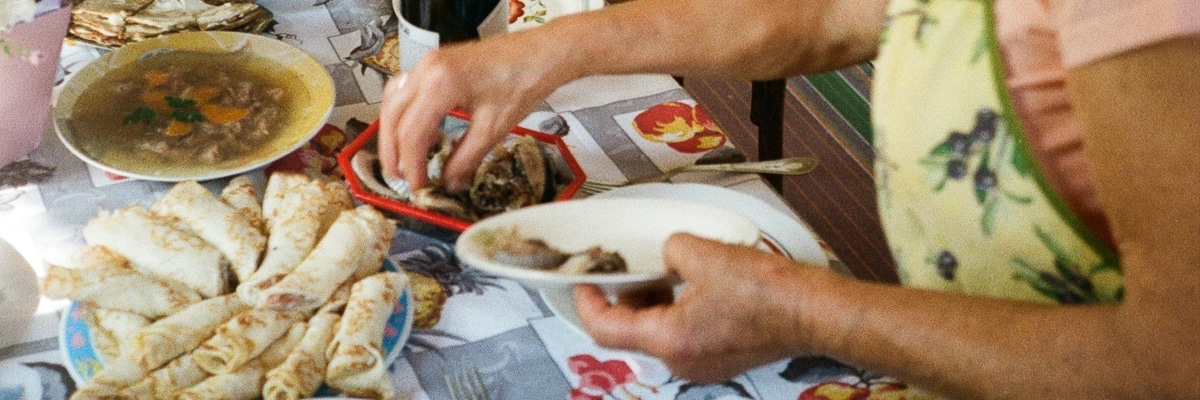
Image credit and inspiration: Anastasia Chervinska, untitled (detail), 2022, photo, Unsplash. Click here to enlarge image. Abundance is a table always set, where the meal awaits with quiet grace and there is always enough for all who arrive.