Belonging and Beloved Community
We Conspire is a series from the Center for Action and Contemplation featuring wisdom and stories from the growing Christian contemplative movement. Sign up for the monthly email series and receive a free invitation to practice each month.
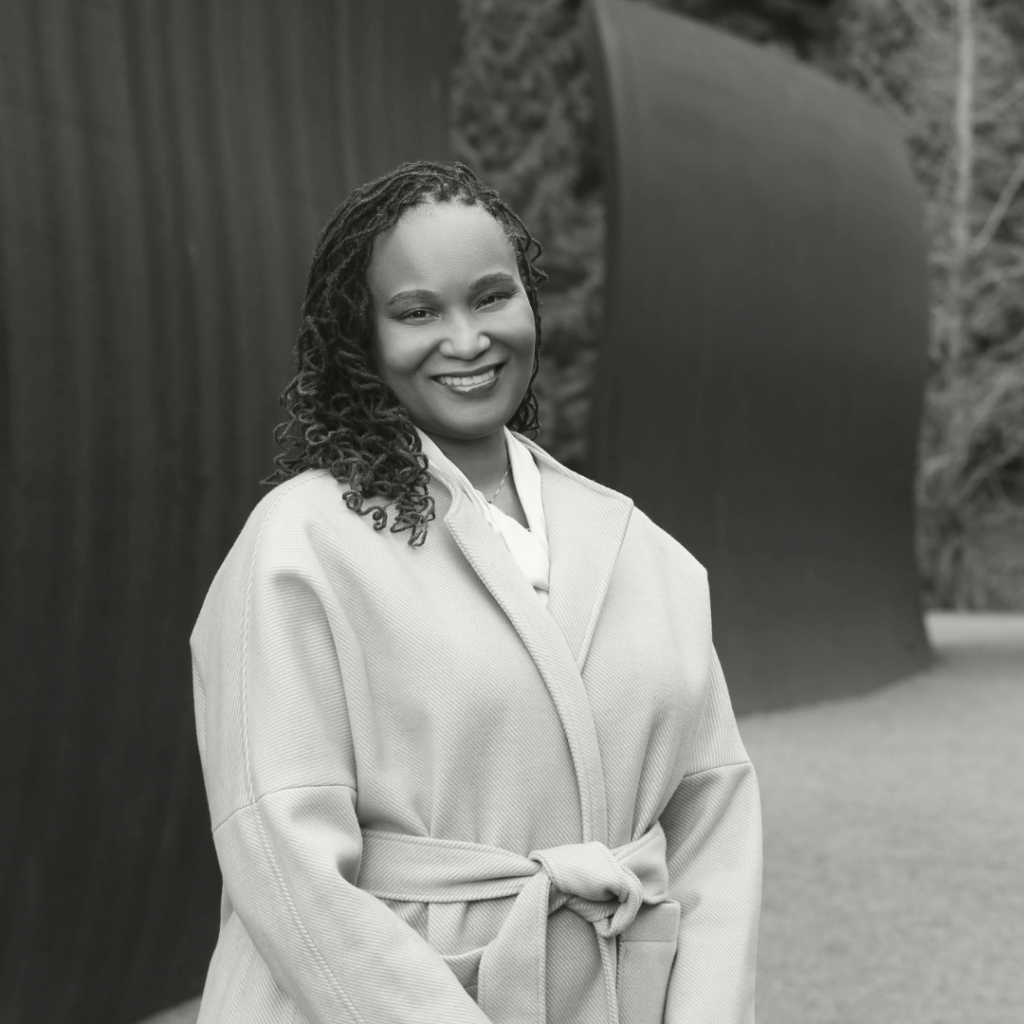
Leonetta Elaiho reflects on her spiritual journey and her work with BIPOC (Black, Indigenous, and People of Color) Centering Prayer retreats to show why honoring identity, culture, and lived experience is not a barrier to unity, but its necessary foundation for the work of Beloved Community.
Leonetta Elaiho’s spiritual journey has taken her across the gamut of Christianity: from her Pentecostal roots, to evangelical youth ministry, to community development work that expanded her theology and led her to Fr. Richard Rohr and the Center for Action and Contemplation (CAC). Discovering the CAC’s resources came with an invigorating feeling: “This is finally a theology that’s expansive enough to hold me for the rest of my life,” she reflects.
She wanted to sign up for the CAC’s Living School but had one hesitancy: Over the years, Elaiho had participated in numerous spiritual formation programs that consisted of “all white folks.” Elaiho is quick to clarify what she means. It can be exhausting, Elaiho shares, to consistently be the one who has a different cultural background in a group. She notes: “It’s difficult for a person to do healing work in a community when they’re asking, ‘Do I belong?’ One of our roles as spiritual practitioners is to counter messages of isolation.” She goes on to reflect on “Beloved Community,” a phrase articulated by Dr. Martin Luther King, Jr. that points toward a way of living rooted in love, dignity, and nonviolence. It names a hope for communities shaped by equity and mutual care. She says, “Beloved Community is a place where great diversity and difference dwell together — where belonging happens and is shared amongst a broad group of kin. There’s unity through difference.”

“Beloved Community is a place where great diversity and difference dwell together — where belonging happens and is shared amongst a broad group of kin. There’s unity through difference.”
—Leonetta Elaiho
Elaiho feels that, too often, spiritual communities leap to unify without first valuing the individual cultural narratives, histories, and experiences that each person brings. The result can be a flattened “unity” that erases rather than elevates difference. A person’s uniqueness flourishes in belonging and becomes its own gift to the Beloved Community. Elaiho feels her experience as a Black woman is not all that she is, but neither should it be suppressed. Similarly, being part of a racial majority or dominant culture is not all that a person is, but neither should it be ignored.
“Sometimes I think in our spiritual communities, we jump to unity — to ‘unitive consciousness’ — and we don’t acknowledge or go deep enough into our own cultural narratives, our own experiences in history, to value what diversity we’re each bringing so that we can actually come to some unitive connection,” Elaiho says. “In order to arrive at Beloved Community, arriving at this unity through diversity, there often is this sacred space of deepening one’s own identity, culture, experiences, and having the safety of that.”
Elaiho says she received an internal green light to apply for CAC’s Living School when she saw that beloved CAC faculty member Dr. Barbara Holmes (1943-2024) was joining the teaching team. Elaiho was comforted that a person on the faculty had a similar cultural background and deeply understood and valued the contemplative traditions and contributions of the Black church and Black people.
Now an alumna of CAC’s Living School program, Elaiho helps organize annual BIPOC Centering Prayer retreats. [1] The retreat, supported by Awakenings and Contemplative Outreach, reflects the growing need for community spaces that support and nurture BIPOC contemplatives through practice. The retreat itself has limited capacity, but the opportunity for more participation happens during Monday morning Centering Prayer calls, in which Elaiho also participates.
In speaking about her involvement in BIPOC Centering Prayer retreats, Elaiho emphasizes that these gatherings are opportunities to participate in Beloved Community. She uses the late Howard Thurman’s famous 1980 baccalaureate speech at Spelman College in Atlanta, Georgia, where he speaks to “the sound of the genuine” as a model to explain the value of racial and other affinity groups, which are associations of people who share a common identity, interest, background, or purpose. In Thurman’s speech, he encourages those in attendance to listen for the sound of the genuine within themselves. The discovery of uniqueness in one’s own being ultimately makes way for hearing and receiving how this sound plays in the lives of others in the Beloved Community — but often that can’t happen without first listening for the sound within oneself. The discovery of the sound of the genuine within oneself often must unfold in a place where someone feels safe and experiences a deep sense of belonging. That’s where affinity groups come in, which can be especially important where there is a dominant culture permeating the community.
“Belonging is the baseline in the grand arc of community building.” —Leonetta Elaiho

“It’s been nice to have a community of like-minded folks where things can be acknowledged and challenged and don’t require as much labor to translate or to communicate because of a shared background,” she says of those who participate in the BIPOC Centering Prayer group. She cautions, though: “But that always has to be toward the end of less separation and more inclusion. If there is a tribe pushing towards isolation, towards disconnection of the ‘other,’ then the question must be asked, as Thurman does: ‘Whose strings are we at the end of?’ If we’re not at the end of love, if it doesn’t bring us into greater union; if it brings us into isolation, then it’s a false gospel, a false community.”
This tension is part of the beautiful dance of Beloved Community. Union makes way for the occasional “rumble,” a word Elaiho returns to often, for the community knows its unitive core can hold the tension, which allows diversity to flow all the more. “Belonging is the baseline in the grand arc of community building,” Elaiho says. “And hearing the sound of the genuine in ourselves, and then in others, is audacious enough of an ambition that is very hard for most institutions and places to achieve. It’s big and hardy enough to keep us busy for a very long time.”
In addition to her work with BIPOC Centering Prayer Retreats, Leonetta Elaiho is also a spiritual director, champion of inclusive spiritual formation, and founder of Beautifulle, an organization dedicated to discovering beauty in broken places. Her work intersects culture, faith, and social justice, but its heart beats toward one audacious goal: Beloved Community.
Reference:
[1] The acronym BIPOC stands for Black, Indigenous, and People of Color.
Reflect with Us
Leonetta Elaiho reminds us that belonging is not something we bypass on the way to unity, but the ground from which Beloved Community grows. When identity, culture, and lived experience are honored, difference becomes a gift rather than a barrier. Where in your life do you feel a deep sense of belonging — or the longing for it? What part of your own story might need space, safety, or attention in order to fully show up in community with others? Share your reflection with us.
We Conspire is a series from the Center for Action and Contemplation featuring wisdom and stories from the growing Christian contemplative movement. Sign up for the monthly email series and receive a free invitation to practice each month.