Inside the CAC Library: Curating Wisdom for Future Generations
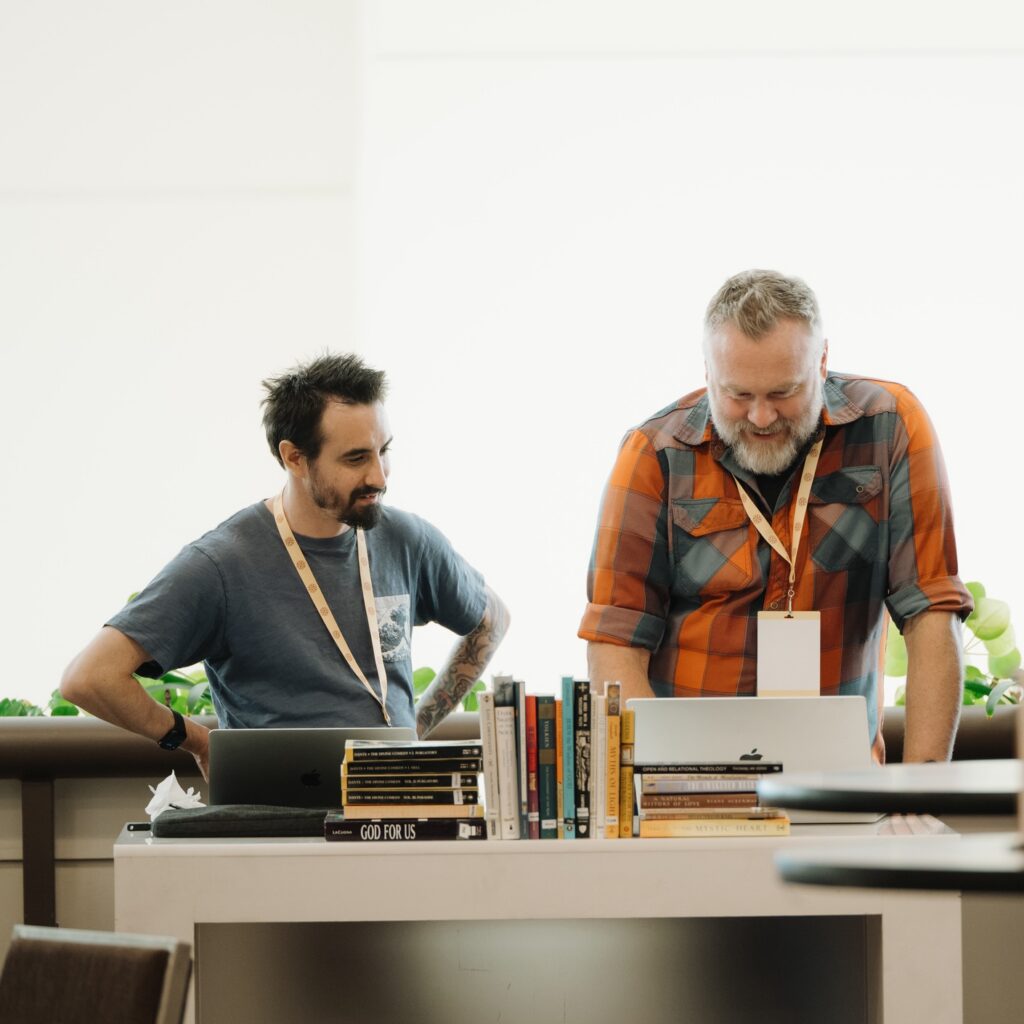
At the Center for Action and Contemplation (CAC), our mission is to introduce Christian contemplative wisdom and practices that support transformation and inspire loving action. This work happens through Daily Meditations, online gatherings, podcasts, courses, publications, and teaching. But behind every offering is another kind of faithful work: the careful stewardship of the teachings, recordings, research, and resources that help make CAC’s mission possible.
That is where the CAC library team comes in.
The library function at CAC is not simply about shelves of books, though books remain part of the work. It is about preserving wisdom, organizing information, supporting research, and helping ensure that contemplative teaching remains accessible to staff, faculty, students, and future generations of seekers.
A Hidden Work of Stewardship
For Lee Staman, CAC’s Library Director, the love of libraries began early. “I’ve always enjoyed libraries for as long as I can remember,” Lee says. “The joy of browsing the stacks and reading all of the spines waiting for something to grab my attention was a constant joy.”
That lifelong love eventually became a vocation rooted in curiosity, service, and the belief that a single sentence or idea can change the direction of a life. Lee often returns to a line from writer Alberto Manguel: “There is a line of poetry, a sentence in a fable, a word in an essay, by which my existence is justified; find that line, and immortality is assured.”
Seth Wilmor, CAC’s Cataloger/Archivist, came to the work through literature, archives, and a deepening sense of call. After studying English Literature as an undergraduate, Seth developed a particular love for his university’s library and archives, where he encountered rare materials including an original Shakespeare folio and original William Blake metal prints.
“It took me several years to realize librarianship was my calling,” Seth says. “I tried working in publishing and public education after college, and eventually decided to get my Master’s in Library Science.”
Together, Lee and Seth help tend the resources that support CAC’s teaching life, not as a static collection, but as a living body of wisdom meant to be studied, practiced, and carried forward.
More than Shelves: What Librarians Really Do
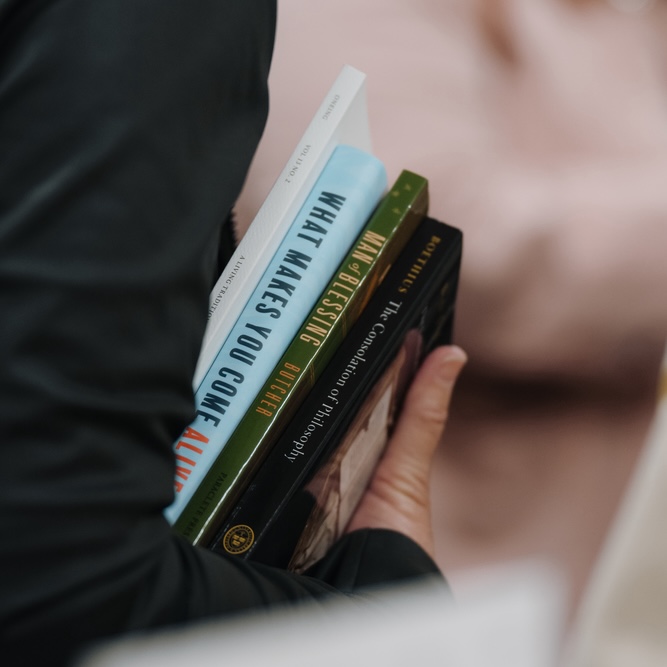
When people imagine a librarian, they may picture someone surrounded by books. Lee remembers a different image offered by the young son of a coworker.
“Upon meeting me for the first time and learning I was a librarian, the young son of a coworker said, ‘Librarians are the last great wizards,’” Lee says. “I think that might capture what it looks like we do from the outside, somehow pulling information out of nowhere.”
Lee explains that in large academic libraries, the work is often divided among subject librarians, reference librarians, technical services librarians, archival librarians, research librarians, and acquisitions librarians. “For many years at the CAC, I held all of these roles,” Lee says, “helping students with research, acquiring materials for staff and faculty, and organizing all of the audio and visual materials that we had of Fr. Richard.”
At CAC, that means organizing materials so they are searchable, supporting research, answering questions, and helping preserve the history of CAC and Fr. Richard Rohr’s work.
“We organize assets so that they’re easy to access,” Seth says. “We do research for people because we’re trained to find information quickly. We answer questions of all magnitudes. And we hold the history of the CAC and Fr. Richard’s work so that it can be preserved and accessed by all.”
Preserving the Teachings for Future Generations
The CAC library team’s work is especially important because so much of CAC’s teaching life has unfolded across many formats and decades: cassette recordings, audio and video teachings, written materials, course resources, publications, and the continuing work of faculty and staff.
As CAC’s archivist, Seth organizes and catalogs digitized audio and video assets, from Fr. Richard’s first cassette tape recordings to content CAC produces today. He archives these materials and makes them searchable for CAC staff. He also supports staff research, assists Lee with reference questions, and conducts research for the Daily Meditations.
Lee’s work as the Librarian also includes researching answers to questions from staff, members of the public, and students taking CAC online courses. He helps organize new materials that need to be digitized and cataloged, while continuing the administrative work that supports the library’s ongoing care of CAC’s resources.
Both Lee and Seth describe preservation as central to the library vocation.
“The preservation of knowledge is one of the most important values of librarians, if not the most important,” Lee says. “By preserving and creating access, future generations are able to make new discoveries when encountering seemingly ancient content.”
Seth names this same value as a responsibility that extends beyond the technical work of cataloging. “I believe the preservation of information is valuable on principle,” Seth says. “Information can be a time machine, a guide, and it can contain valuable lessons as societies progress.”
“I hold spiritual teaching to be the most valuable to preserve and to continue learning from. Without it, spiritual traditions become susceptible to abuse.”
—Seth Wilmor
A Living Tradition, Carefully Held
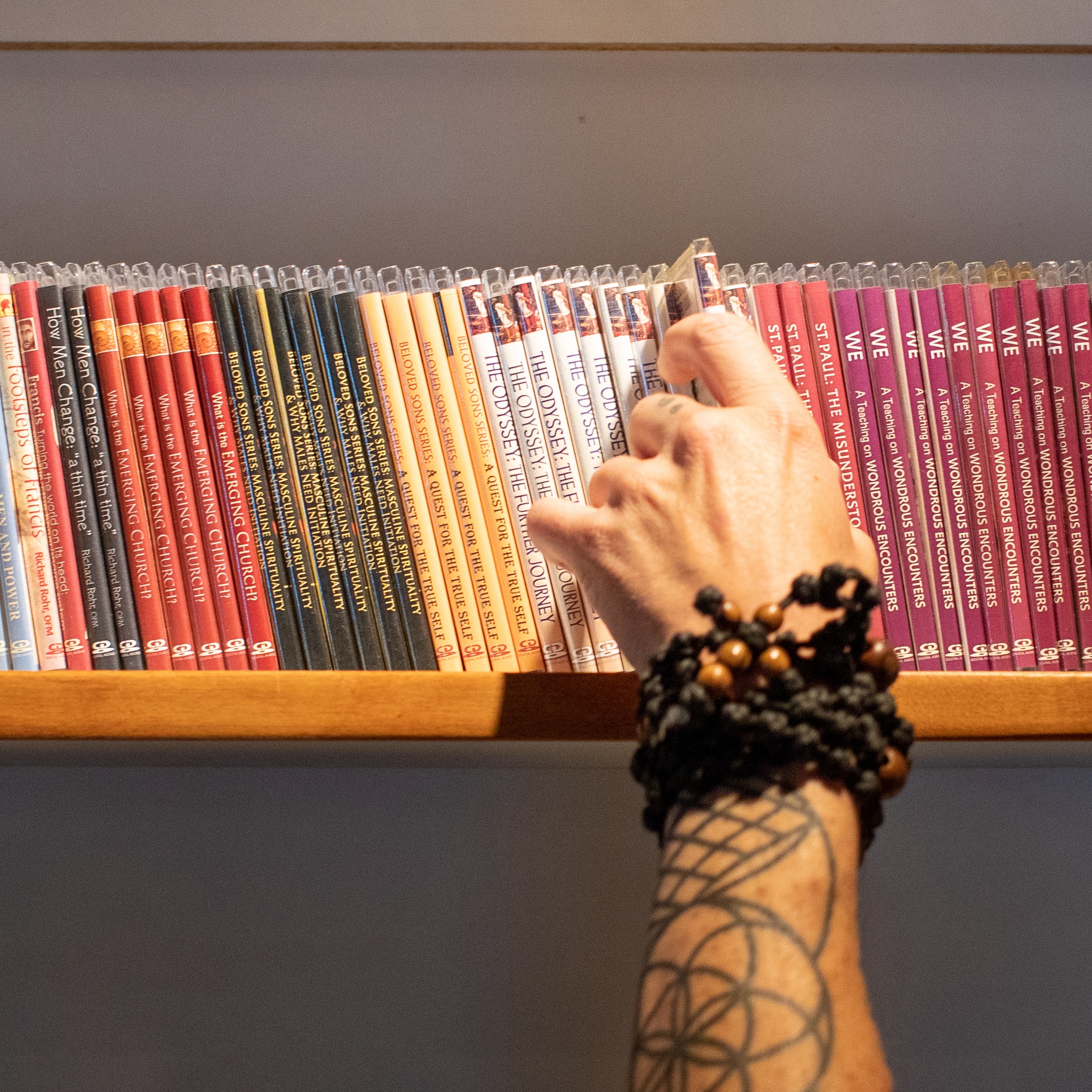
For CAC, preserving and organizing wisdom resources matters because contemplative teaching is not static information. It is a living tradition, meant to be received, practiced, embodied, and carried into new contexts.
Seth says this is especially true of spiritual teaching. “I hold spiritual teaching to be the most valuable to preserve and to continue learning from,” he says. “Without it, spiritual traditions become susceptible to abuse.”
He adds, “We live in a world where history is so often erased by those in power. Preserving wisdom as it is originally taught is among the most important responsibilities of any group or society.”
In this way, the CAC library team’s work supports both memory and mission. It helps keep CAC rooted in the wisdom it has received while supporting the ongoing work of making that wisdom available in forms people can encounter today. Research, reference support, cataloging, archiving, and access all help CAC continue sharing Christian contemplative wisdom with care, accuracy, and depth.
For many people in the wider CAC community, this work may remain mostly invisible, but its impact is present throughout CAC’s offerings: in the teachings that are preserved, the resources drawn from, the questions answered, and the care brought in sharing Christian contemplative wisdom across generations. Wisdom often reaches us because someone has cared enough to preserve it, organize it, and make it possible to find.
How to Connect with the CAC Library
Currently, the CAC library functions mainly as an online resource, which offers some access by contacting Lee and Seth.
CAC Staff may connect with the library team through internal research and reference support. Students in CAC online courses may also encounter the library team through the “Ask the Librarian” space in CAC Connect, where research-related questions can be shared and supported. For members of the wider public, research-related questions may be directed through CAC’s Community Support team, which helps connect inquiries to the right staff members when library support is needed.
Through this quiet stewardship, CAC’s library team helps carry forward a living tradition — one that continues to invite seekers into deeper wisdom, embodied practice, and loving action in the world.
The work of the librarians is made possible thanks to the generosity of friends and supporters of the CAC. If you’re interested in making a gift to share the wisdom and practices of the Christian contemplative tradition through CAC’s archives, you are invited to learn more about how to give.