Father Richard writes about the transformative power of accepting our own belovedness:
We can only transform people to the degree that we have been transformed. We can only lead others as far as we have gone. We have no ability to affirm or to communicate to another person that they are good or special until we know it strongly ourselves. Once we get our own “narcissistic fix,” as I call it, then we can stop worrying about being on center stage, and we have plenty of time and energy to promote other people’s empowerment and specialness. Only beloved people can pass on belovedness.
If we do not understand election as inclusive election (chosenness is for the sake of communicating the same to others), religion almost always becomes an exclusionary system against the “non-elect,” “unworthy,” or “impure.” It becomes “my belonging system” instead of any good news for the world, which is exactly what Jesus did not do. In any kind of exclusive election, the “chosen one” does not see their experience as a gift for others, but merely a gift for themselves. This creates a very smug and self-satisfied religion.
I would encourage you to take your time and read through both Deuteronomy 7:7–9 and Romans 11. There, you’ll see how both Moses and Paul beautifully teach about chosenness and election. It’s not to make people think they are better than others or to create a society of the superior ones. If anything, in fact, it is the gathering of the weak and the wounded, to show how God transforms and heals.
Jesus knew who his best audiovisual aids were for his transformative message: “I did not come for the healthy, but for the sick” (see Luke 5:31–32). The lives of saints and mystics never point to themselves, but always and forever beyond themselves to the One who chooses them, uses them, and loves them. They become models for us. [1]
To allow ourselves to be God’s beloved is to be God’s beloved. To allow ourselves to be chosen is to be chosen. To allow ourselves to be blessed is to be blessed. It is so hard to accept being accepted, especially from God. It takes a certain kind of humility to surrender to it, and even more to persist in believing it. Any persons used by God know this to be true: God chooses and then uses whom God chooses, and their usability comes from their willingness to allow themselves to be chosen in the first place. What a paradox!
God’s love is constant and irrevocable; our part is to be open to it and let it transform us. There is absolutely nothing we can do to make God love us more than God already does, and there is absolutely nothing we can do to make God love us less. We are stuck with it! The only difference is between those who allow it and those who don’t. They are both equally and objectively the beloved, but one just enjoys it and draws ever-new life from that realization. [2]
References:
[1] Adapted from Richard Rohr, Things Hidden: Scripture as Spirituality (Franciscan Media, 2022), 44–45.
[2] Adapted from Rohr, Things Hidden, 182.
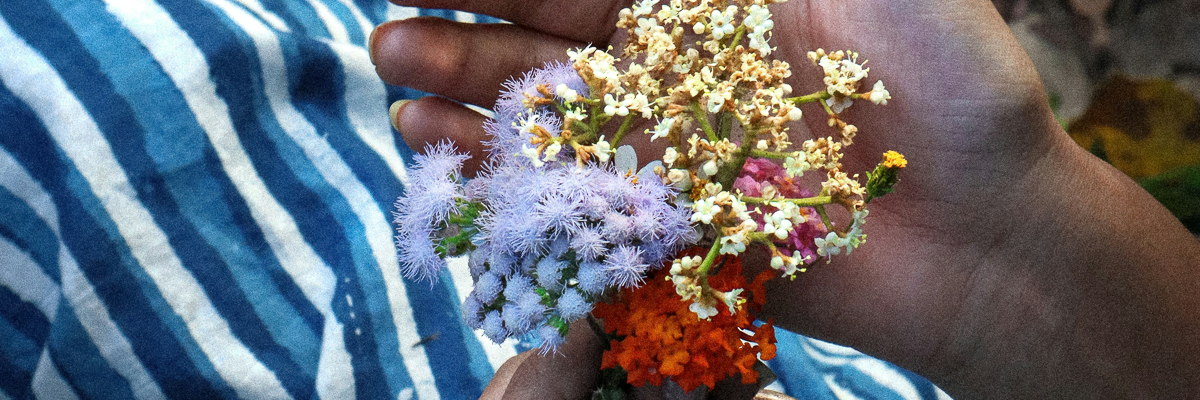
Image credit and inspiration: Credits: Tony Sebastian, untitled (detail), 2019, photo, India, Unsplash. Click here to enlarge image. Like a bouquet of many different kinds of flowers, we are all gently held as beautifully chosen and beloved.


Story from Our Community:
I have always felt that being an introvert was a character flaw and tried without much success to be more gregarious. Through these meditations and Father Richard’s teachings, I have come to accept this as a blessing and realize that I am not alone. I am cradled in the Trinity’s all-encompassing embrace.
—Veronica S.

