Father Richard reflects on God’s tenderness towards us, even when we make decisions that harm ourselves or others:
Alienated people stop trusting that reality is good, that we are good too, and that we belong—to God and to one another. By eating of the fruit of the tree of the knowledge of good and evil, Adam’s and Eve’s eyes were opened to a split universe of suspicion and doubt.
Adam and Eve offer the perfect metaphor for this new split universe, this intense awareness of themselves as separate and cut off. Today, we might call it their encounter with primal shame. Every human being seems to have it in some form: that deep sense of being inadequate, insecure, separate, judged, and apart. It’s almost the human condition, yet it takes a thousand disguises, showing up uniquely in each of us. It’s this sense of disconnection, however, that creates the yearning for divine re-connection and re-communion.
While Adam and Eve “sewed fig leaves together to make themselves loincloths” (3:7) in response to their newly discovered “nakedness,” there really is no medicine for this existential shame, apart from Someone who possibly knows all of us and loves us anyway. That can only be God! Perhaps that’s what’s meant when we say, “God alone can ‘save’ you.” God says to them, “But who told you that you were naked?” (3:11), undoing their doubt. God creates a doubt in the opposite direction and in their favor.
When the Significant Other says we are good, then we are good indeed. That’s what it means, psychologically speaking, to be liberated and loved by God. Other people can say it, but we will always doubt it, even though it feels good and may temporarily work. It is often the necessary “bottle opener.”
This safe and protective God, the one who does not reject humanity, is illustrated in a most tender way: God is presented as a divine seamstress: “God sewed together clothes for them out of the skins of animals and they put them on” (3:21).
Surely this is a promise from a protective and nurturing God who takes away their shame and self-loathing. That will become the momentum-building story of the whole Bible, which gradually undoes the common history of fearsome and threatening deities.
God takes away the shame we have by giving us back to ourselves—by giving us God! It doesn’t get any better than that.
Human love does the same thing. When someone else loves us, they give us not just themselves, but for some reason, they give us back our own self—now a truer and better self. This dance between the Lover and the beloved is the psychology of the whole Bible.
Once humans are outside of union—symbolized by the garden—the whole pattern of fear, hatred, violence, and envy begins. Much of the rest of the Bible will reveal the conflicts of living outside the garden—in other words, in the dualistic mind of disunion—and yet with the constant invitation back into union.
Reference:
Adapted from Richard Rohr, Things Hidden: Scripture as Spirituality, rev. ed. (Franciscan Media, 2022), 40–42.
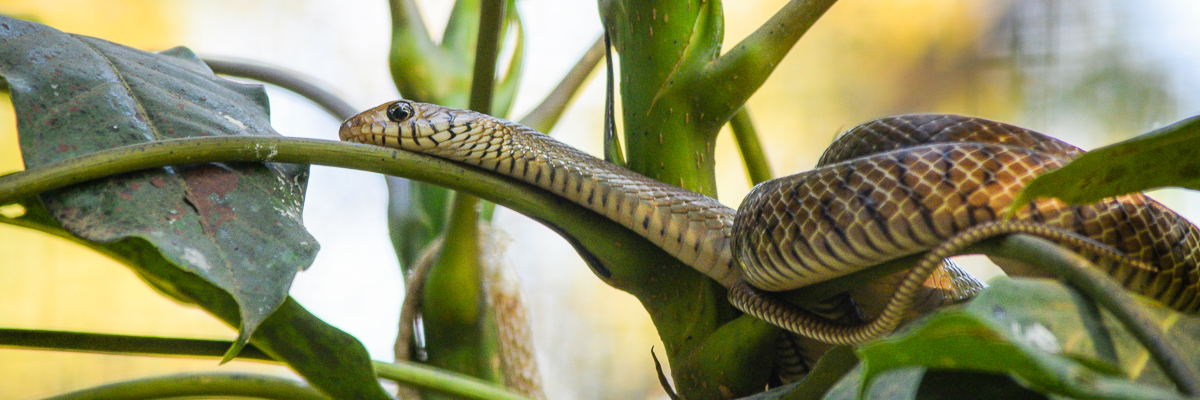
Image credit and inspiration: Abishek Rana, untitled (detail), 2020, photo, Unsplash. Click here to enlarge image. A serpent in a garden invites us to pause. We are reminded that maturing means discerning between venom and challenge. Can we step from innocence into experience—while being held in intimate relationship with God?


Story from Our Community:
Loving all of creation as Christ taught us could return us to Eden, to heaven on earth. I imagine the possibilities: no war, no hatred, no discrimination or bigotry. Everyone working for the good of others to erase famine, ease suffering, and create a society where everyone is given the opportunity to be the best version of themselves. If we love as Christ loves, no one would be excluded.
—Reino P.

