Sunday
We must take the risk of legitimate attachment (fully feeling the emotion), learn its important message, and then have the presence and purpose to detach from that fascinating emotion after it has done its work. This is the gift and power of an emotionally mature person.
—Richard Rohr
Monday
Emotions are, first of all, a gift from God so that we can touch upon reality by a way other than our brain.
—Richard Rohr
Tuesday
To feel an emotion is to allow it and let it run through, to learn from what it is telling you about you, about your relationships. Feeling is a self-acceptance of your own emotions and the wisdom of your body.
—Prentis Hemphill
Wednesday
Contemplation liberates me from being a perpetual prisoner of my trains of thoughts and feelings; it helps me realize that I am not my thoughts and feelings. It helps me see that these inner reactions and negotiations happen to me and within me without my consent, like digestion, like sleep, like fatigue or laughter.
—Brian McLaren
Thursday
Whenever we recognize an outsized emotional response, we can be pretty certain that we are over-identified with something or our shadow self has just been activated and exposed. If we are ultimately incapable of detaching from an emotion, we are far too attached!
—Richard Rohr
Friday
What passion always refers to in the ancient texts is this peculiar, compulsive nature of stuck emotion. The passions are really stuck emotions, revolving around themselves to generate drama.
—Cynthia Bourgeault
Week Thirty-Four Practice
What Do You Feel?
Psychologist Hillary McBride describes the impact of suppressing emotions:
Feelings are both bodily and social, acting as sensory communication to us and to those around us. But not everyone knows how to respond in healthy and supportive ways to this form of communication. Growing up, we might have learned that some feelings were dangerous or untrustworthy, would cause us to be alone, or would create distress in others. We learned ways of expressing feelings that suited those around us, or we learned to defend against the feelings to protect ourselves and others from the pain of them.
But our unfelt feelings, like any other essential bodily processes, do not go away even if we try to repress them. They eventually catch up with us and get our attention somehow, sometimes in the form of disease, mental health issues, illness, burnout, addiction, or pain. To get back to our core self, the wise, creative, steady, compassionate, and connected present-day self, we need to learn to be with our feelings as they happen and to trust that our bodies know what to do with them, as long as our mental and cultural stories do not get in the way.
McBride offers several journaling prompts to explore our relationship with our emotions:
Growing up, the feelings I was allowed to feel were …
I learned that it would be dangerous to feel …
The feelings that I have learned to label as negative are …
I am afraid that if I feel ______ (fear, sadness, joy, disgust, excitement, anger, desire), then I might …
When I was little, I needed to learn that feelings …
Reference:
Hillary L. McBride, Practices for Embodied Living: Experiencing the Wisdom of Your Body (Brazos Press, 2024), 81–83.
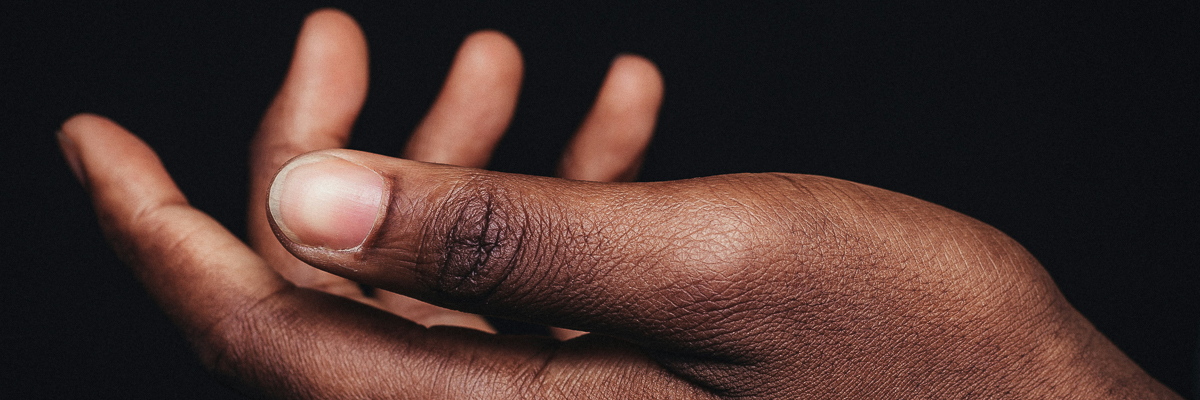
Image credit and inspiration: Nsey Benajah, untitled (detail), 2020, photo, Unsplash. Click here to enlarge image. A gentle openness, relaxed and present, welcomes each moment as it is; neither clinging to feeling nor fleeing from it—simply accepting and allowing it to flow through.


