Even if hope fails, something bigger can replace it, and that is love.
—Brian McLaren, Life After Doom
Brian McLaren suggests that love can serve as a deep source of hope that is not dependent on outcome:
If we can see a likely path to our desired outcome, we have hope; if we can see no possible path to our desired outcome, we have despair. If we are unsure whether there is a possible path or not, we keep hope alive, but it remains vulnerable to defeat if that path is closed.
When our prime motive is love, a different logic comes into play. We find courage and confidence, not in the likelihood of a good outcome, but in our commitment to love. Love may or may not provide a way through to a solution to our predicament, but it will provide a way forward in our predicament, one step into the unknown at a time. Sustained by this fierce love (as my friend Jacqui Lewis calls it), we may persevere long enough that, to our surprise, a new way may appear where there had been no way. At that point, we will have reasons for hope again. But even if hope never returns, we will live by love through our final breath.
To put it differently, even if we lose hope for a good outcome, we need not lose hope of being good people, as we are able: courageous, wise, kind, loving, “in defiance of all that is bad around us.” [1] …
We feel arising within us this sustained declaration: We will live as beautifully, bravely, and kindly as we can as long as we can, no matter how ugly, scary, and mean the world becomes, even if failure and death seem inevitable. In fact, it is only in the context of failure and death that this virtue develops. That’s why Richard Rohr describes this kind of hope as “the fruit of a learned capacity to suffer wisely and generously. You come out much larger and that largeness becomes your hope.” [2]
The ecotheologian Sallie McFague (1933–2019) centers hope in our faith in God, who is love:
As we consider the basis for our hope, let us recall who God is…. The hope we have lies in the radical transcendence of God…. God’s transcendence—God’s power of creative, redeeming, and sustaining love—is closer to us than we are to ourselves. God is the milieu, the source, of power and love in which our world, our fragile, deteriorating world, exists. The world is not left to fend for itself, nor is God “in addition” to anything, everything. Rather, God is the life, love, truth, goodness, and beauty that empower the universe and shine out from it….
This faith, not in ourselves, but in God, can free us to live lives of radical change. Perhaps it is the only thing that can. We do not rely on such hope as a way to escape personal responsibility—“Let God do it”—but rather this hope frees us from the pressure of outcomes so that we can add our best efforts to the task at hand. [3]
References:
[1] Howard Zinn, You Can’t Be Neutral on a Moving Train: A Personal History of Our Times (Beacon Press, 1994), 208.
[2] Richard Rohr, A Lever and a Place to Stand: The Contemplative Stance, the Active Prayer (Hidden Spring, 2011), 104; Brian D. McLaren, Life After Doom: Wisdom and Courage for a World Falling Apart (St. Martin’s Essentials, 2024), 84–85.
[3] Sallie McFague, A New Climate for Theology: God, the World, and Global Warming (Fortress Press, 2008), 169, 171.
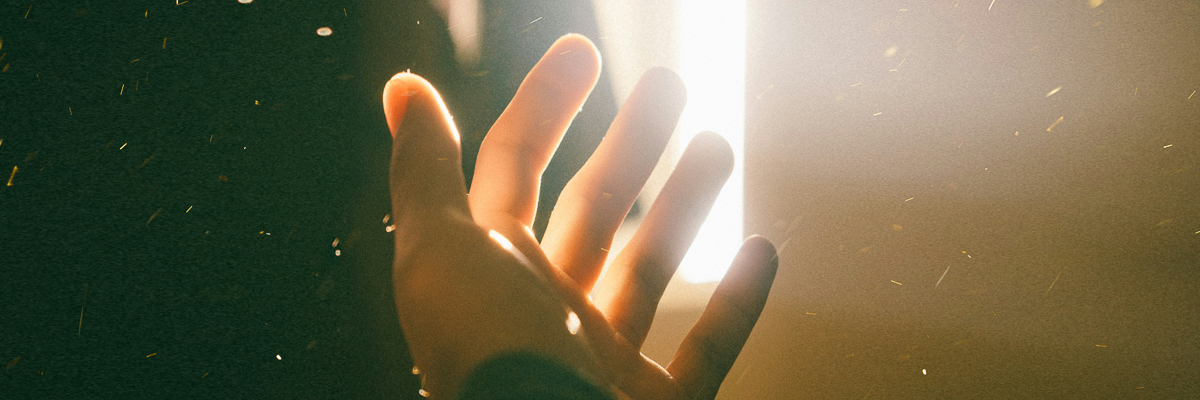
Image credit and inspiration: Dyu Ha, untitled (detail), 2019, photo, Unsplash. Click here to enlarge image. We reach out with a deep desire to connect to hope and a sense of timing beyond our own.


Story from Our Community:
Decades ago, while struggling with my Catholic faith, I was given Adam’s Return by Richard Rohr. Since then I have read many of his books, visited the CAC, and read his Daily Meditations. My Catholic identity is enhanced and feels like a blessing that shapes how I see and engage with the world.
— Bill M.

