When Hip-Hop Becomes Sacred Song
We Conspire is a series from the Center for Action and Contemplation featuring wisdom and stories from the growing Christian contemplative movement. Sign up for the monthly email series and receive a free invitation to practice each month.
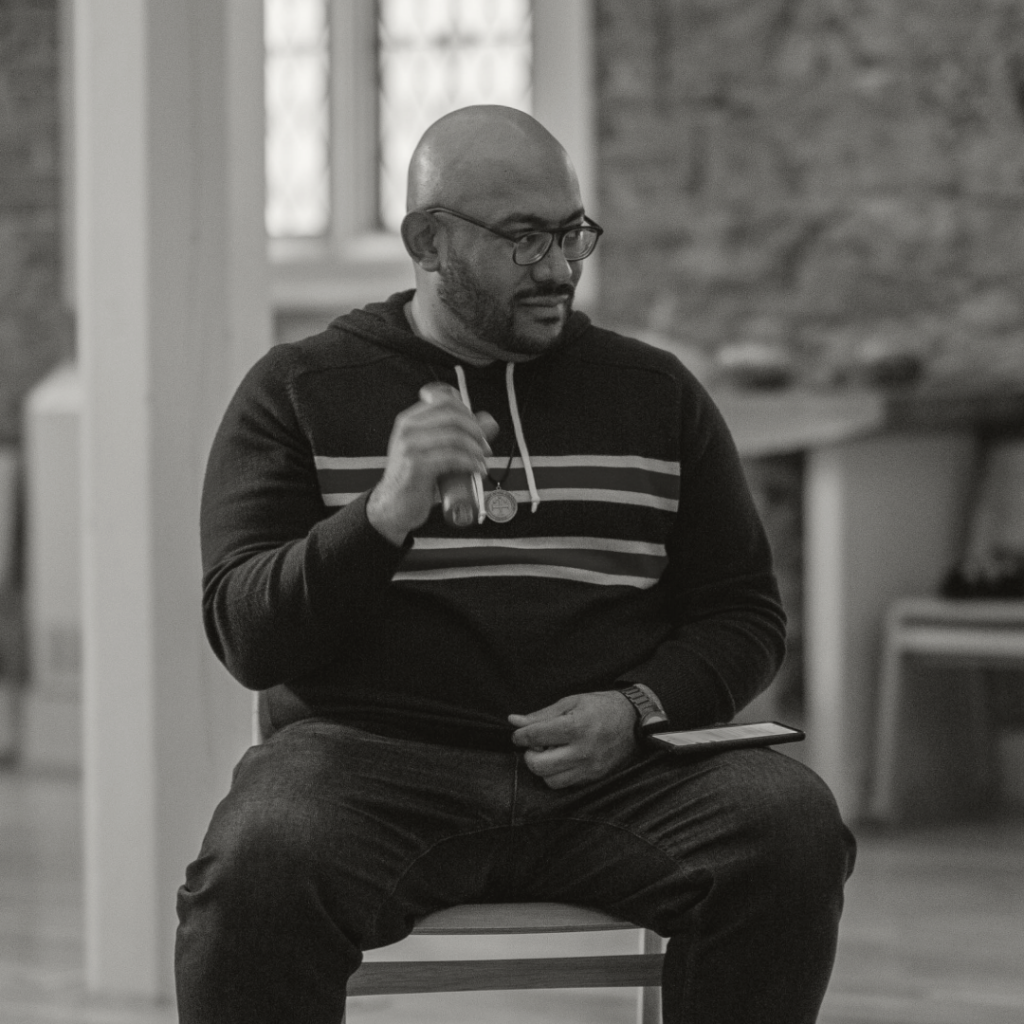
What happens when a hip-hop song becomes sacred music through which to pray? Josué Perea invites seekers into Hip-Hop Musica Divina, a monthly contemplative gathering offered by Black Lives and Contemplation, a project of the Center for Spiritual Imagination. Through practice and community, Perea shows how expanding the language and mediums of prayer can open new, more inclusive ways of belonging and help reimagine what Beloved Community can look like in a divided world.
Josué Perea was still glowing from the night before.
Perea’s project “Black Lives & Contemplation,” through the Center for Spiritual Imagination, hosts a virtual gathering on the third Thursday of each month to communally engage in musica divina, or “sacred listening.” This practice is an adaptation of lectio divina — an ancient practice honed by monks and nuns throughout the centuries, which is traditionally done with a passage from Scripture. The sacred text Perea invited practitioners to mull over the night before? The hip-hop song “i,” sometimes referred to as “I Love Myself,” by rapper/poet Kendrick Lamar.

“We encourage people to treat music as a sacred text, a sacred offering.” — Josué Perea
“Hip-Hop Musica Divina” arose from Perea’s struggle to belong throughout his spiritual journey. Raised in Colombia in the Pentecostal tradition, his family immigrated to New York City when he was ten. His father, a Black Colombian, was a Pentecostal pastor who overcame racism in law school to become a lawyer. Instead of suppressing critical questions about faith, his father’s legal background caused him to encourage Perea to “ask all the questions you want.” By eleven years old, Perea preached his first sermon and by sixteen, he served as a licensed minister in the Pentecostal tradition. At seventeen, he attended seminary — but he never stopped heeding his father’s advice and asking questions. Yet the denomination’s reticence for spiritual curiosity and erasure of its own history — downplaying Black founder William J. Seymour in favor of white figures — left Perea feeling displaced. Outspoken and brash in his youth, he challenged hypocrisies, once retorting in a ministers’ meeting that Jesus himself wouldn’t pass their dress code.
By his early twenties, Perea left the Pentecostal church. The rejection stung deeply, compounding a personal crisis: a painful breakup, family stresses, and undiagnosed depression. “I had nothing,” he recalls. The spirituality he had known offered platitudes such as “everything happens for a reason,” but no tools for navigating suffering. Perea hit rock bottom.
Salvation came unexpectedly during Advent 2013, at Holy Cross Monastery in West Park, New York. Invited by a friend, he encountered contemplative prayer in the serene setting. “It grounded me,” he says. No longer chasing ecstasy or answers, Perea found what he didn’t know he was looking for in silence, breath, and presence. This sparked a twelve-year journey. He earned a master’s degree in theology, pastoring a progressive Disciples of Christ church in Harlem and discerning a call to deeper community. He eventually landed in the Community of the Incarnation, a contemplative group that offers a four-year cycle of spiritual formation exploring Carmelite, Benedictine, and Franciscan traditions, culminating in lifelong “new monastic vows.” One thing he noticed, however, as he delved into the Christian contemplative tradition, was that most communities and experiences overwhelmingly consisted of white and older people. Says Perea: “I began to wonder: ‘How could I help create spaces that invite people to contemplative practice and to figure out a way to engage with other music, reading, or art in a different way that is nurturing for one’s spirit?”
The Community of the Incarnation’s ministry, a nonprofit called the Center for Spiritual Imagination, birthed a new project: “Black Lives & Contemplation.”
“How can we also center Black wisdom and Black lived experience while learning about contemplative practice?” —Josué Perea

Black Lives & Contemplation participants are mostly from Atlanta and New York City — where Perea resides and also hosts in-person gatherings — but have also joined from as far away as Guatemala and South Africa. Perea was genuinely moved the night before to find a number of teenagers in attendance. Think about that: seventeen-year-olds learning about contemplative prayer and practice, attracted to the gathering because of the medium of hip-hop.
“There needs to be different introductions for contemplative practice,” Perea shares. “A Beloved Community is one that doesn’t have many walls up and lines drawn. It isn’t one that prevents access. I’m still relishing [our last gathering],” he beams.
Perea first invited participants to listen to “i” by Lamar. They listened for a second time while reading the lyrics. Then they listened for a third time while watching the music video. Participants were invited to “rest in silence” to allow whatever was stirring within them to rise to the surface. Then Perea opened the floor for sharing and reflection. One person talked about having recently lost their spouse and how the song pierced through the grief. Another participant was in the hospital with her mother and talked about how her soul needed this time of connection and contemplation. One teenager opened up about their struggle with self-love, one of the themes of the song. Also in attendance was Lamar scholar Sequoia Maner, who helped the group explore the lyrics, images, and philosophical and spiritual dimensions of the song.
“We encourage people to treat the music as a sacred text, a sacred offering,” Perea reflects. “Can they learn these things from Thomas Merton? Absolutely. Can they also learn these things from Kendrick Lamar? Well, clearly, they did. In creating the Beloved Community, we ask questions: How can we make contemplative practice expansive and invitational? How can we center Black wisdom and Black lived experience while learning about contemplative practice?” Perea, back in ministry, lives the final vow of Lamar’s “i”: giving himself again — until the well runs dry.
Reflect with Us
Josué Perea’s work invites us to imagine prayer beyond familiar forms. When music, story, or art becomes a sacred text, new pathways into contemplation and belonging can open — especially for those who have felt unseen or unheard. What sounds or creative expressions help you listen more deeply to yourself and to others? Where might the sacred be waiting for you in unexpected places? Share your reflection with us.
We Conspire is a series from the Center for Action and Contemplation featuring wisdom and stories from the growing Christian contemplative movement. Sign up for the monthly email series and receive a free invitation to practice each month.