Becoming an Instrument of Joy
We Conspire is a series from the Center for Action and Contemplation featuring wisdom and stories from the growing Christian contemplative movement. Sign up for the monthly email series and receive a free invitation to practice each month.
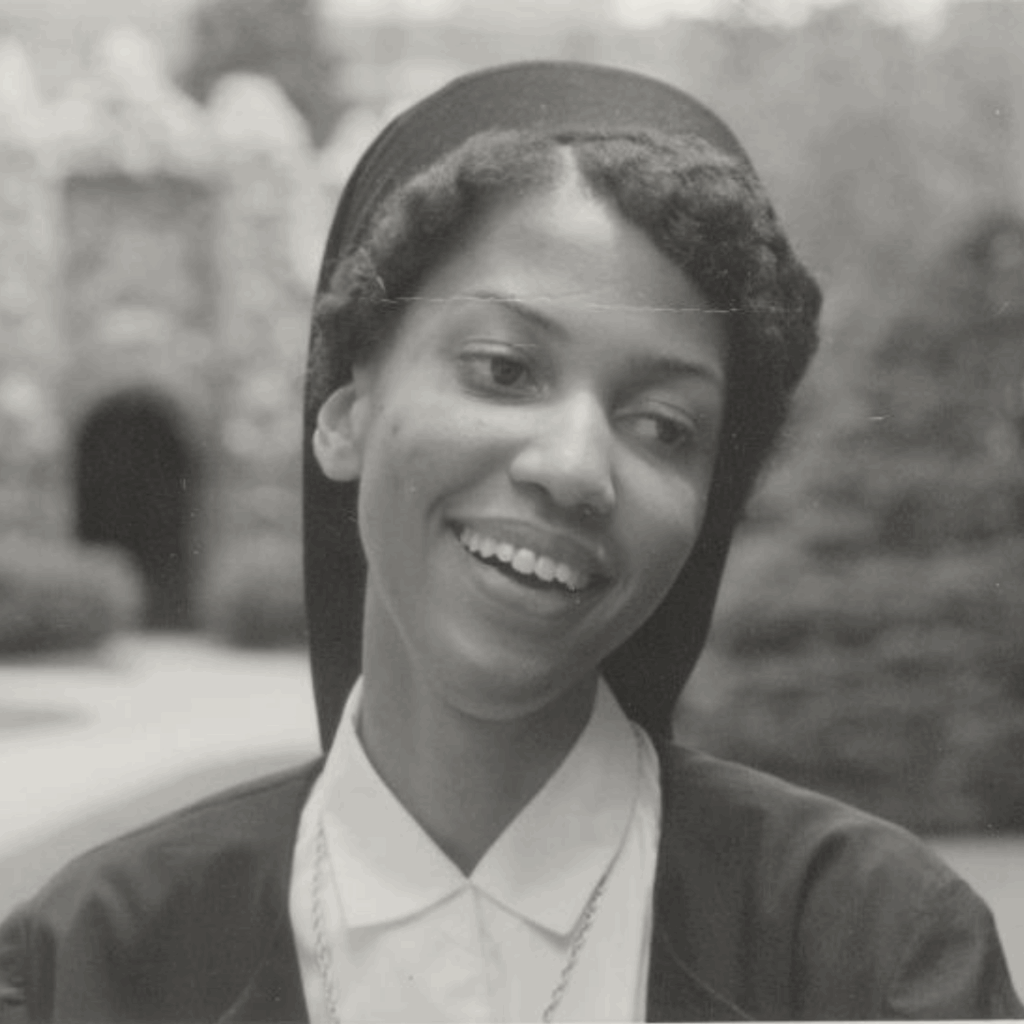
How does contemplation awaken us to live our lives as instruments of joy? In June’s “We Conspire” series, we highlight the embodied faith and joyful presence of Sister Thea Bowman (1937-1990). Sister Thea’s gospel ministry of song, storytelling, and cultural celebration inspired the global church and gave voice to the vibrancy of the African diaspora.
Thea Bowman, born Bertha Elizabeth Bowman in 1937, and raised in Canton, Mississippi, was the only child of Dr. Theon Bowman, a physician, and Mary Esther Bowman, a teacher. She converted to Catholicism at nine-years old inspired by the “lived witness” of committed Catholic sisters and priests who worked to support people in her community suffering from poverty and marginalization.
Bowman’s life changed when she encountered the religious community of the Franciscan Sisters of Perpetual Adoration (FSPA). These nuns, sent from La Crosse, Wisconsin, dedicated themselves to supporting the education of Black youth. “The black public schools were tremendously disadvantaged and understaffed,” Bowman recollected. [1] Young Bertha Bowman’s parents placed her at the FSPA’s Holy Child Jesus Catholic School in Canton, where she grew, learned, and thrived.
At the age of 15, Bowman’s sought to join the sisterhood for good, which would take her to the FSPA’s “motherhouse” in Wisconsin. Initially her parents did not support her move, and Bertha stopped eating in protest until they relented! Bertha Bowman moved 900 miles from Canton to the majority-white La Crosse, Wisconsin, where she became the first Black woman to join the FSPA. Given the monastic name “Thea,” inspired by her father Theon and a fourth-century saint named Thea, Bertha Bowman became Sister Thea Bowman.

We don’t want to change the theology of the church. We just want to express theology within the roots of our Afro-centric spiritual culture. —Sister Thea Bowman
Sister Thea’s joy grew in pursuit of education and in sharing her gifts of teaching with others. Bowman lived in Washington D.C. studying English literature, earning both master’s and doctorate degrees. In the classroom, whether in Canton with children, at Viterbo College in Wisconsin or at the Institute for Black Catholic Studies—which she helped found—at Xavier University, Bowman took joy in helping others discover their passion, gifts, and capacity for learning.
The late 1960s marked a transformative period for Sister Thea, both spiritually and culturally. The Second Vatican Council’s liturgical renewal inspired her to reconnect with her African-American religious heritage and spirituality. “We don’t want to change the theology of the church. We just want to express theology within the roots of our Afro-centric spiritual culture,” she stated. [2] She brought her full and joyful self to ministry, viewing different cultures, races and ethnicities as gifts for the wider church. Sister Thea sang Black spirituals, incorporated dancing, and storytelling in her popular presentations across the United States. She shared her intellectual gifts through teaching courses on Black Literature and Black Spirituality, all while educating the wider church about African American musical traditions. She supported the publication of the first African American Catholic Hymnal, Lead Me, Guide Me, writing the introduction.
Black is beautiful. You have to believe it.… And some children have a hard time saying that. When I say that I am beautiful, what does that mean? It means I am caring. It means I respect myself. It means that I am confident. —Sister Thea Bowman

The civil rights movement inspired in her a passion for racial justice and an affirmation that “Black is beautiful.” In an interview with Mike Wallace of 60 Minutes, Sister Thea spoke of the importance of honoring racial identity with children. Bowman said, “Black is beautiful. You have to believe it,” nudging Wallace to say “Black is beautiful” on national television. She continued, “And some children have a hard time saying that. When I say that I am beautiful, what does that mean? It means I am caring. It means I respect myself. It means that I am confident.” [3] Sister Thea became a leader promoting cultural awareness, first through her diocese in Jackson, Mississippi, and eventually throughout the world in such places as the International Eucharistic Congress in Nairobi. She emphasized the importance of mutuality in celebrating cultural gifts, and she always demonstrated an eagerness to learn from other cultures while sharing her own.
In 1984, Sister Thea faced devastating challenges: the deaths of both her parents and a diagnosis of breast cancer. Despite the pain and difficulty of traveling as the cancer spreads to her bones, she remained committed to sharing her love for God and the joy of the gospel. Her friends and students encouraged her to choose life, and Sister Thea vowed to “live until I die.” [4]

I come to my Church fully functioning. I bring myself; my Black self, all that I am, all that I have, all that I hope to become. —Sister Thea Bowman
She did not let the deterioration of her body keep her from one unprecedented event. In 1989, Sister Thea addressed the U.S. Bishops at their annual June meeting held in 1989 at Seton Hall University in East Orange, NJ. Speaking from her wheelchair, she told the bishops, “I come to my Church fully functioning. I bring myself; my Black self, all that I am, all that I have, all that I hope to become. I bring my whole history, my traditions, my experience, my culture, my African-American song and dance and gesture and movement and teaching and preaching and healing and responsibility – as gifts to the Church.” [5] Sister Thea urged the bishops to heal alienation with love, encouraging them that in Christ’s unity, healing from poverty, loneliness, clericalism, sexism, and racism is possible.
Sister Thea Bowman’s life was marked by gospel joy, enduring faith, and persevering prayer even in the face of racial prejudice, cultural insensitivity, and debilitating illness. Her personal holiness reflected the faith and endurance of her ancestors, the hope expressed in the spirituals, compassion for the poor and marginalized, devotion to the Eucharist, and the radical love embodied in her Franciscan tradition by St. Francis.
Sister Thea Bowman impacted many lives throughout her vibrant ministry. Sister Francesca Thompson, a Franciscan nun, put it this way: “I don’t know who Thea was, but I know she was sent by God. She was the God-gilded ice sent dancing, swaying, sashaying into our lives. She was song. She was the joyous Franciscan always.” [6]
References:
[1] As quoted in Maurice J. Nutt, Thea Bowman: Faithful and Free (Liturgical Press, 2019), 23.
[2] Yingst, Kreg. Everything Could Be A Prayer: One Hundred Portraits of Saints and Mystics (Broadleaf Books, 2024), 202.
[3] Thea Bowman, as quoted in Nutt, Faithful and Free, 102.
[4] Thea Bowman, as quoted in Nutt, Faithful and Free, 114.
[5] Thea Bowman, “Address to the U.S. Bishops,” conference presentation, June 17, 1989
[6] Mary Queen Donnelly, “Sister Thea Bowman (1937–1990),” America, April 28, 1990, https://www.americamagazine.org/issue/100/sister-thea-bowman-1937-1990. Accessed May 23, 2025.
Image: Franciscan Sisters of Perpetual Adoration | fspa.org/theabowman
Reflect with Us
How might you embody joy as a form of liberation? In what ways can your cultural roots, creativity, or voice become instruments of healing in a divided world? As you reflect on Sister Thea Bowman’s witness, how are you being called to bring your whole self—your history, gifts, and presence—as a blessing to your community and the wider church? Share your reflection with us.
“We Conspire” is a series from the Center for Action and Contemplation featuring wisdom and stories from the growing Christian contemplative movement. Sign up for the monthly email series and receive a free invitation to practice each month.