A Call to Boundless Love and Inherent Dignity
We Conspire is a series from the Center for Action and Contemplation featuring wisdom and stories from the growing Christian contemplative movement. Sign up for the monthly email series and receive a free invitation to practice each month.
How does contemplation invite us to nonviolent, radical love? In July’s “We Conspire” series, learn how spiritual trailblazer Howard Thurman’s contemplative grounding shaped a revolutionary commitment to nonviolence that lasts to this day.
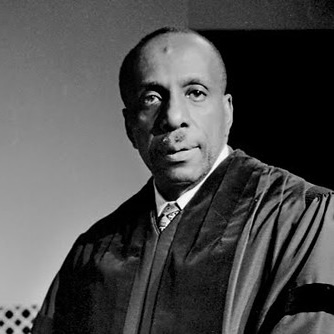
In a world often consumed by division and discord, Howard Thurman emerges as a beacon of hope, offering a clarion call to nonviolence rooted in radical love and the inherent dignity of every human being. From his humble beginnings in the segregated community of Waycross to his transformative encounters with global leaders, Thurman’s journey illuminates a path toward true human flourishing, challenging us to embrace a universal vision of God and the interconnectedness of all life.
Born in Daytona, Florida, just decades after the abolition of slavery, Thurman’s worldview was deeply shaped by the experiences of his maternal grandmother, Nancy Ambrose, who had endured the horrors of enslavement. This visceral connection to the spiritual and psychological plight of his people fueled his lifelong quest to understand the “head and heart” of humanity. [1] A brilliant scholar, Thurman graduated as valedictorian from Morehouse College in 1923 and was ordained a Baptist minister two years later. His intellectual prowess and deep spiritual insight quickly propelled him to prominence, serving as the first dean of Andrew Rankin Chapel at Howard University. [2]

Thurman’s enduring message was one of steadfast conviction and boundless love.
A pivotal moment in Thurman’s intellectual and spiritual development occurred in 1935 when, as chair of the Delegation of Friendship for the World Student Christian Federation, he journeyed to India and met with Mahatma Gandhi. This encounter significantly deepened Thurman’s understanding of nonviolence, an ideal Gandhi described not merely as an idea, but as “the only true force in life.” [3] Gandhi emphasized that the efficacy of nonviolence hinged on its embrace by the masses, not just by leaders—a crucial insight that would resonate throughout Thurman’s work. [4]
Upon his return, Thurman put his convictions into action. In 1944, alongside Albert Frisk, he co-founded The Church for the Fellowship of All Peoples in San Francisco. This pioneering effort underscored his unwavering commitment to a Christianity that transcended racial and social barriers. His influence continued to grow, and in 1953, Thurman made history as the first full-time African American professor and dean of Daniel L. Marsh Chapel at Boston University. That same year, Life Magazine recognized him as “one of the twelve best preachers of the 20th century,” a testament to his profound impact on religious thought and practice. [5]
Every living thing … belongs to every other living thing, and I can never be what I ought to be until the last living manifestation of Life is what it ought to be. —Howard Thurman

Thurman’s enduring message was one of steadfast conviction and boundless love. Offering a powerful antidote to the corrupted Christianity of white segregationists, Thurman preached a Christianity which “appears as a technique of survival for the oppressed.” Jesus, he writes, “announced the good news that fear, hypocrisy, and hatred, the three hounds of hell that track the trail of the disinherited, need have no dominion over [the oppressed].” [6] The key to overcoming these hounds of hell, Thurman teaches, is “the love-ethic” at the heart of Christianity. [7]
Central to Thurman’s philosophy was the concept of the “relational self,” a being constantly seeking to experience God in all people, places, and things. He believed that “all of life, society, cultural norms, and the created world are our interpretative mechanisms for accessing and encountering God.” [8] This deep orientation toward connection and synthesis informed his perspective on social action, which he saw as the removal of “all that prevents God from coming to [fullness] in the life of the individual.” [9]

In a world still grappling with prejudice, violence, and division, Howard Thurman’s voice resonates with timeless urgency.
Thurman was a vocal critic of Western forms of Christianity that he felt had distorted the message of Jesus, transforming it into an affirmation of dominance and privilege rather than a powerful critique of “violent separateness and acts of power over others.” [10] For Thurman, creative, transformative, and lasting social change necessitated an inclusive vision. As he eloquently stated, “Every living thing … belongs to every other living thing, and I can never be what I ought to be until the last living manifestation of Life is what it ought to be. For better or for worse I am tied into the idiom of everything that lives. And if I forget this, I profane God’s creation.” [11]
In a world still grappling with prejudice, violence, and division, Howard Thurman’s voice resonates with timeless urgency. His profound insights into nonviolence, rooted in the inherent dignity of the individual and the interconnectedness of all life, offer a compelling blueprint for a more just and compassionate future. His legacy reminds us that true strength lies not in domination, but in the power of love and the unwavering commitment to the sacred worth of every human soul.
References:
[1] Shively T.J. Smith, “Thurman-eutics: Howard Thurman’s ‘Clothesline’ for the Interpretation of the Life of the Mind and Journey of the Spirit,” in Anchored in the Current: Discovering Howard Thurman as Educator, Activist, Guide, and Prophet, ed. Gregory C. Ellison II, (Westminster John Knox Press, 2020), 75.
[2] Howard Thurman, With Head and Heart: The Autobiography of Howard Thurman (Houghton Mifflin Harcourt, 1979), 88.
[3] Peter Eisenstadt, Against the Hounds of Hell: A Life of Howard Thurman (University of Virginia Press, 2021), 5.
[4] Thurman, With Head and Heart, 132–133.
[5] “Great Preachers: These 12–and Others–Bring Americans Back to the Churches.” Life Magazine (6 April 1953), 127-132.
[6] Howard Thurman, Jesus and the Disinherited, (Abingdon-Cokesbury Press, 1949), 29.
[7] Thurman, Jesus and the Disinherited, 89
[8] Smith, Shively T.J, “Thurman-eutics,” Anchored in the Current, 76-77.
[9] Howard Thurman, “Mysticism and Social Action” Lawrence Lecture on Religion and Society, First Unitarian Church of Berkeley, Kensington, CA, October 13, 1978.
[10] Smith, “Thurman-eutics,” Anchored in the Current, 79.
[11] Arleigh Prelow, Howard Thurman: Spirit of a Movement, documentary short, directed by Arleigh Prelow (San Francisco: Inspirit Communication and Film, 2005), commissioned by the Museum of the African Diaspora.
Reflect with Us
What might it mean to root your resistance in love rather than fear? Howard Thurman taught that nonviolence begins with a deep inner transformation—an awareness of the sacred dignity in ourselves and in others. As you reflect on his life and teachings, consider where you may be called to confront injustice without mirroring its violence. How might you cultivate a contemplative practice that softens the heart, disarms the ego, and opens you to the divine presence in all living beings?
Share your reflection with us.
“We Conspire” is a series from the Center for Action and Contemplation featuring wisdom and stories from the growing Christian contemplative movement. Sign up for the monthly email series and receive a free invitation to practice each month.