What Do We Do with the Bible?: Weekly Summary
Sunday
The Bible, as a text in travail, mirrors and charts our own human travail and illustrates all these stages from within the Bible. It offers both the mature and immature responses to almost everything, and we have to learn the difference.
—Richard Rohr
Monday
If you long for a deeper, more mystical relationship with the unnameable mystery we call God, then read the Bible like a mystic: like someone whose life has been illuminated and transformed by immersion in the very heart of divine love. Read from the heart of compassionate love, not from fear or any anxious need to please, placate, or control.
—Carl McColman
Tuesday
We have on our hands a Bible as complicated and dynamic as our relationship with God, one that reads less like divine monologue and more like an intimate conversation.
—Rachel Held Evans
Wednesday
It takes all the Bible—and sometimes all our lives—to get beyond the punitiveness and pettiness that we project onto God and that we harbor within ourselves. We have to keep connecting the dots of God’s wisdom and grace.
—Richard Rohr
Thursday
The Gospel says, “He would never speak to them except in parables” (Matthew 13:34). The indirect, metaphorical, symbolic language of a story or parable seems to be Jesus’s preferred way of teaching spiritual realities.
—Richard Rohr
Friday
To refuse ourselves these stories is a death by starvation. These spiritual stories sustained our spiritual forebears; without these stories, I suggest that we cannot maintain the imagination required to nurture belief.
—Liz Charlotte Grant
Week Four Practice
Dancing with Scripture
Biblical scholars Christopher Hoklotubbe and Daniel Zacharias describe an Indigenous way of reading the Bible as a circle or dance that makes room for all that is encouraging and difficult. As Oglala Lakota elder Black Elk wrote, “You will notice that everything the Indian does is in a circle … the power from the sacred hoop.” [1]
The relationship we have with Jesus informs and shapes our relationship with Scripture. We recognize Jesus as a brown-skinned Indigenous man whose land was colonized. He was shaped by the stories of his people and the revelations that came from Creator and were written down by the Hebrew prophets. We have been adopted into the global and multiethnic family of Jesus; he is our elder brother (Mark 3:34–35; Romans 8:15–17, Galatians 4:4–7). As we are now adopted into his family as kin, his ancestral stories and histories have now become part of our stories and histories as we join into the faith family of Abraham (Galatians 3:7). These stories do not replace our previous stories and histories but join the dance circle. The words of Scripture have become the wisdom of our adoptive elders and ancestors. The desire for the Scriptures to dominate as the sole authority, denigrating and replacing Indigenous cultural traditions, is a colonizing form of Christianity that Indigenous people the world over have encountered.
Indigenous followers of Christ do not enter into this relationship blissfully ignorant and unwilling to reckon with the sometimes harsh realities of the biblical text.… Indigenous encounters with the biblical text have not shied away from wrestling with and critiquing the biblical text. Jacob/Israel encountered God at Bethel and wrestled through the night with him (Genesis 32:22–31). He left the encounter with a blessing but also with a limp. The Scriptures today are like a modern-day Bethel for the family of faith—a place in which we encounter God and can leave the encounter blessed or bruised, sometimes both simultaneously. But in the midst of these encounters, we maintain our hope in the power of the “God-breathed” or “inspired” Scriptures (2 Timothy 3:16) to give life to those who hold them as sacred.
References:
[1] Raymond J. DeMallie, The Sixth Grandfather: Black Elk’s Teachings Given to John G. Neihardt (University of Nebraska Press, 1984), 290.
T. Christopher Hoklotubbe and H. Daniel Zacharias, Reading the Bible on Turtle Island: An Invitation to North American Indigenous Interpretation (IVP Academic, 2025), 8–10.
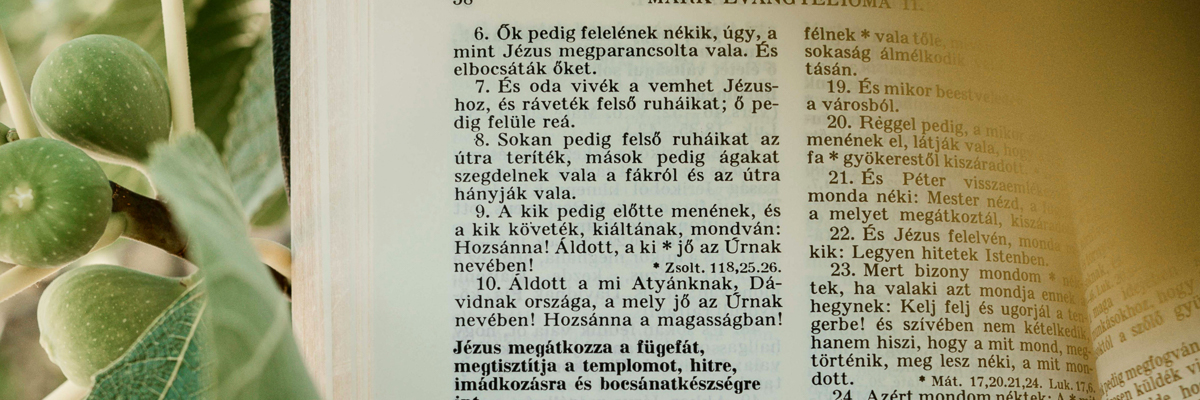
Image credit and inspiration: Image credit and inspiration: Paréj Richárd, untitled (detail), 2021, photo, Unsplash. Click here to enlarge image. Our relationship with the Bible may shift—sometimes clear, sometimes mysterious—yet still holding the promise of a greening, growing thing.