Father Richard Rohr encourages us to read the Bible seeking an inner experience instead of authoritative answers:
The amazing wonder of the biblical revelation is that God is very different than we thought and much better than we feared. To paraphrase what evolutionary biologist J.B.S. Haldane wrote about the universe, “God is not only stranger than we think, but stranger than we can think.” [1] God is not bad news but, in fact, overwhelmingly comforting and good news.
This is what Walter Brueggemann, in Theology of the Old Testament, calls a “credo of five adjectives” that continually recurs in the Hebrew Scriptures: This God that Israel—and Jesus—discovered is consistently seen to be “merciful, gracious, faithful, forgiving, and steadfast in love.” [2]
It’s taken us a long time to even consider that could be true. The only people who really know it to be true for themselves are those who sincerely seek, pray, and often suffer. Outside of inner experience, those are just five more pious words. Outside of our own inner experience of this kind of God, most religion will remain merely ritualistic, moralistic, and doctrinaire.
If we believe in inspiration, and trust that the Spirit was guiding the Bible’s listening and writing—but, like all things human, “through a glass darkly” (1 Corinthians 13:12), we will allow ourselves to be led. We will trust that there is a development of crucial divine wisdom inside this anthology of books we call the Bible. Woven amidst these developing ideas are what I have called the “Great Themes of Scripture.”
When we get to the Risen Jesus, there’s nothing to be afraid of in God. Jesus’s very breath is identified with forgiveness and the Divine Shalom (John 20:20–23). If the Risen Jesus is the final revelation of the nature of God’s heart, then we live in a safe and loving universe. But it’s not that God has changed, or that the Hebrew God is a different God than the God of Jesus. It’s that we are growing up as we move through the biblical texts and deepen our experience. God doesn’t change, but our readiness for such a God takes a long time to change. If we stay with the text and tend to our inner life with God, our capacity for God will increase and deepen. If we read the Bible merely searching for certain conclusions so we can quickly reassure our “false self,” our spiritual growth will just stop. We will also become a rather toxic person for ourselves and others.
Just as the Bible takes us through many stages of consciousness and salvation history, it takes us individually a long time to move beyond our need to be dualistic, judgmental, accusatory, fearful, blaming, egocentric, and earning-oriented. The text in travail mirrors and charts our own human travail and illustrates all these stages from within the Bible. It offers both the mature and immature responses to almost everything—and we have to learn how to recognize the difference.
References:
[1] J.B.S. Haldane, Possible Worlds and Other Essays (Chatto and Windus, 1927), 286. The original quote read: “Now, my suspicion is that the universe is not only queerer than we suppose, but queerer than we can suppose.”
[2] Walter Brueggemann, Theology of the Old Testament: Testimony, Dispute, Advocacy (Fortress Press, 1997), 216.
Adapted from Richard Rohr, Things Hidden: Scripture as Spirituality (Franciscan Media, 2022), 5, 7–8.
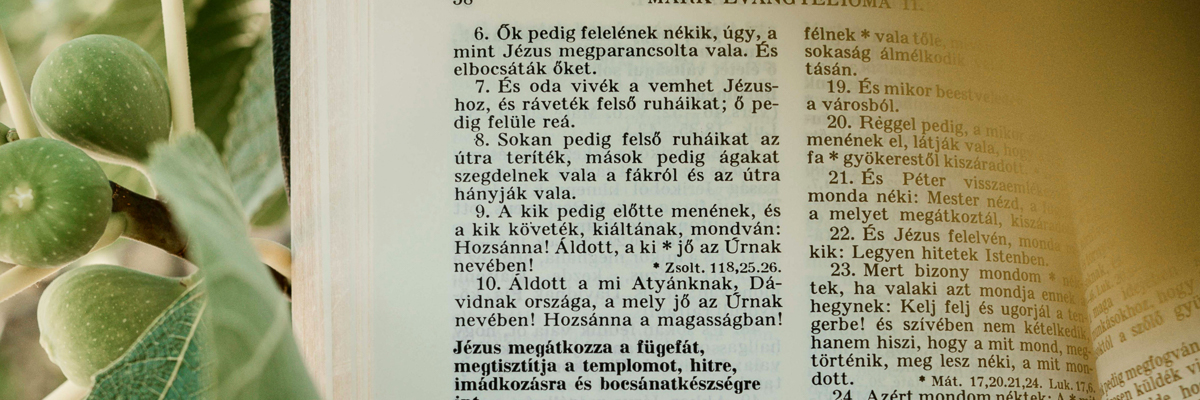
Image credit and inspiration: Image credit and inspiration: Paréj Richárd, untitled (detail), 2021, photo, Unsplash. Click here to enlarge image. Our relationship with the Bible may shift—sometimes clear, sometimes mysterious—yet still holding the promise of a greening, growing thing.


Story from Our Community:
In a meditation Father Richard quotes G. K. Chesterton, “Our religion is not the church we belong to, but the cosmos we live inside of.” It brought me immediately to a “Yes!” and back to an experience I had at church while pondering Scripture. I wrote in my journal afterward, “As I listened and pondered, I felt as though I were inside a beautiful poem where Scripture is the poem of all life’s experiences. Poems aren’t descriptions of actual occurrences, but of beauty and mystery behind occurrences.” In my experience, Scripture isn’t the news of times past, but poetry for all time.
—Carol T.

