The good news or the living “Word of God” is personified in Jesus but is communicated throughout Scripture.
—Richard Rohr, The Great Themes of Scripture: Old Testament
For many of us, the Bible has been both a source of wisdom and a source of wounding. It has inspired liberation and love, just as it has also been used to justify domination and division. In 2026, we’ll return to this ancient text with open hearts and new eyes, exploring how it might again speak good news to a fractured world. Brian McLaren shares:
One of the weapons we see people use in our hostilities and fragmentation is the Bible. Many of us have been wounded by the Bible wielded as a weapon. Many of us have wielded the Bible as a weapon ourselves and wounded others. Many of us have just stayed away from the Bible entirely because it feels like something dangerous—a sharpened sword, a loaded gun, a ticking time bomb, a toxic recipe…. But if we learn to read the Bible in conversation with our honest experience and in light of our living traditions, we can learn and model a better way.
Throughout the 2026 Daily Meditations, we will be looking at the Bible in new and fresh ways—as good news for a fractured world. Let me mention three of those new and fresh ways. First, we won’t read the Bible as if it were a divinely dictated book that descended out of heaven on a parachute. Instead, we will be reading the Bible as a set of precious literary artifacts that emerge in the unfolding story of humanity. We will take seriously the historical, social, ecological, economic, and political context of the Bible, and we will dig deep for needed ancient wisdom to help us today.
Second, we won’t read the Bible as if it were a manual to help people dominate and exploit the earth and other people. It certainly has been and is being used in that way, but we will instead explore the Bible for inspiration—for creative and nonviolent resistance to that kind of domination and exploitation.
And third, we won’t read the Bible as if it were an evacuation plan, preparing us to give up on the earth and be beamed up to heaven. Instead, we will explore the Bible as a prompt for both deep contemplation and for deep, loving action.
We will approach the Bible contemplatively, quieting our kneejerk reactions, exposing our deep-seated biases, challenging our untested assumptions, and leading us to see the divine in creation, in our own hearts, and in one another. And, especially in the life and teaching of Jesus, we will see a call to special kind of action in the world—nonviolent action, creative action, Christlike action where leadership looks like service and where the power of love outlasts and overcomes the love of power.
Reference:
[1] Adapted from Brian D. McLaren, 2026 Daily Meditations Theme: Good News for a Fractured World, Center for Action and Contemplation, video, 6:38.
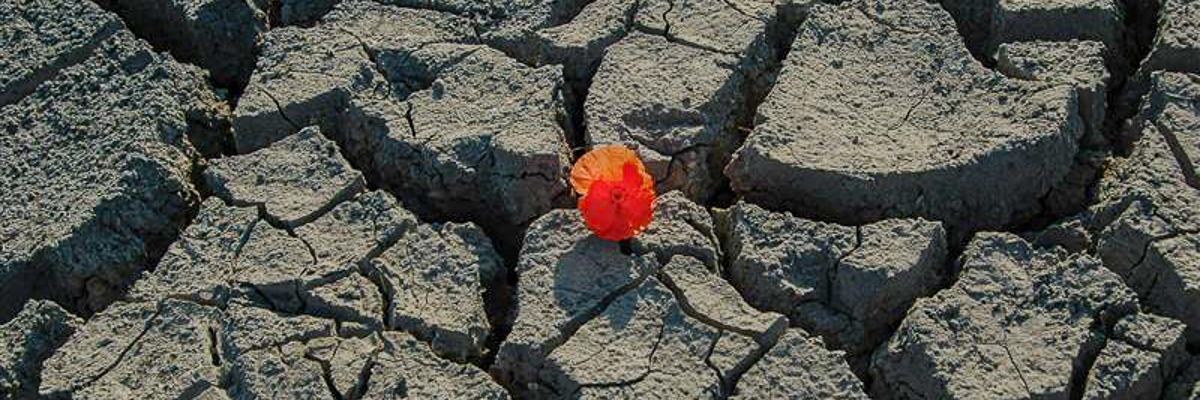
Image credit and inspiration: Paul Macallan, untitled (detail), 2021, photo, Unsplash. Click here to enlarge image. Like this bright flower, the gift of contemplation and action brings us hope in the midst of painful reality.


Story from Our Community:
James Finley says, “God sustains us in all things while protecting us from nothing.” I’ve come to believe that it’s only through seeing God in our suffering that we can truly be free from the fear that causes us to choose ways of being that are not loving. Even in our fear, when we choose not to love, God is there. God has not, could not, and will not ever forsake us. God is not safe, but God is good. It’s the same thing to say that reality is not safe, but reality is good.
—Heather C.

