Father Richard Rohr identifies in Revelation, the last book in the Bible, a “return to the garden” for all of creation:
The whole Bible is trying to return us to the garden. By the end, in the book of Revelation (21–22), the garden becomes the New Jerusalem, where there is no temple, but only the river of life and the trees of life, where even “the leaves are for the cure of the pagans” (22:2) and where “God lives among humans” (21:3).
The Hebrew prophet Ezekiel’s vision (Ezekiel 37:27) has been fulfilled: Humanity has become God’s people, and God has become their God. There is no need for a religious building because the garden itself is the temple. Life is now one sacred reality.
Eden is a symbol of unitive consciousness. We cannot objectively be separate from God. We all walk in the garden whether we know it or not. We came from God and we will return to God. Everything in between is a school of conscious loving.
Authentic spiritual cognition always has the character of re-cognition! We return to where we started and, as T.S. Eliot stated, “know the place for the first time.” [1] As Jacob put it when he awoke from his sleep: “Truly, Yahweh was in this place all the time, and I never knew it” (Genesis 28:16). That is, without doubt, the common knowing of mystics, saints, and all recovered sinners.
Many of the journeys before that point are journeys away from the center, where we literally become “ec-centric.” These are the recurring biblical texts of fall and recovery, hiddenness and discovery, loss and renewal, failure and forgiveness, exile and return.
Fortunately, we are always being led back to the real Center to find who we really are: to find ourselves in God. God seems both very patient and very productive with the journeys back and forth. Such is the pattern of the soul, of history, and of the Bible, a progress of sorts: two steps backward and three forward.
That humble productivity and slow efficiency on God’s part is called “the economy of grace” or the good news. Here, God fills in all the gaps, everything is used, and nothing is wasted, not even sin. It leads to a worldview of abundance and enoughness. Buying and selling is a cheap substitute and always leads to a worldview of scarcity, judgmentalism, fear, and stinginess. Why would anyone want to live there? And yet many, if not most, of us do.
The full biblical revelation has given us the history within the history, the coherence inside of the seeming incoherence. If we don’t get this inner pattern, then religion becomes simply aimless anecdotes—just little stories here and there, with no pattern or direction. They come from no place and there is no place they are going. We have to know where the text is heading or we do not know how to look through the appropriate lenses.
References:
[1] T. S. Eliot, Four Quartets (Harcourt, 1971), 43.
Adapted From Richard Rohr, Things Hidden: Scripture as Spirituality, rev. ed. (Franciscan Media, 2022), 228–230, 231.
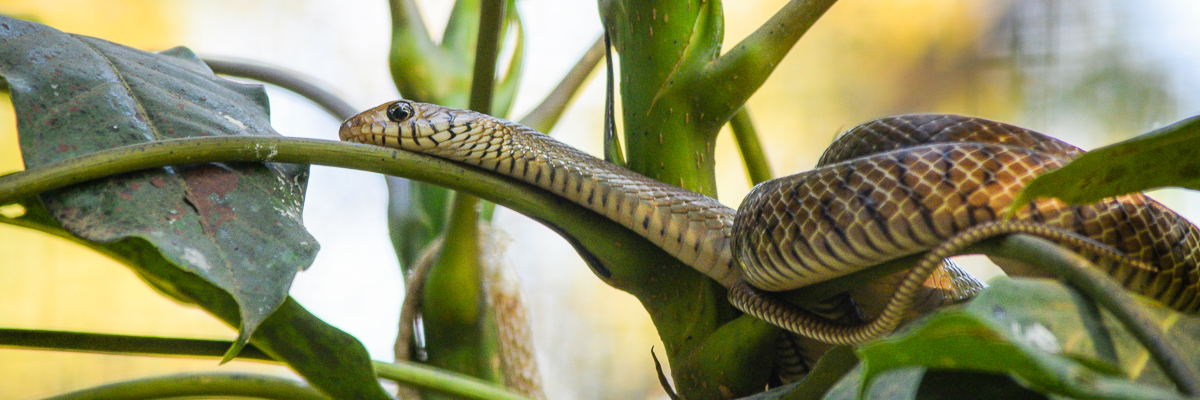
Image credit and inspiration: Abishek Rana, untitled (detail), 2020, photo, Unsplash. Click here to enlarge image. A serpent in a garden invites us to pause. We are reminded that maturing means discerning between venom and challenge. Can we step from innocence into experience—while being held in intimate relationship with God?


Story from Our Community:
A memory of childhood abuse brought me to a halt in midlife. Shame was embedded inside me, and my image of God was tainted. I felt an invitation from God to join God in the desert, to retreat for a season to explore this wound that had been opened. In the “desert,” I spent time with my spiritual director and therapist and engaged in various spiritual practices with God to heal. Meditation transformed my shameful thoughts into belovedness. Centering prayer was like divine therapy. Imaginative prayer showed me how much God loves and accepts me as I am.
—Anne R.

