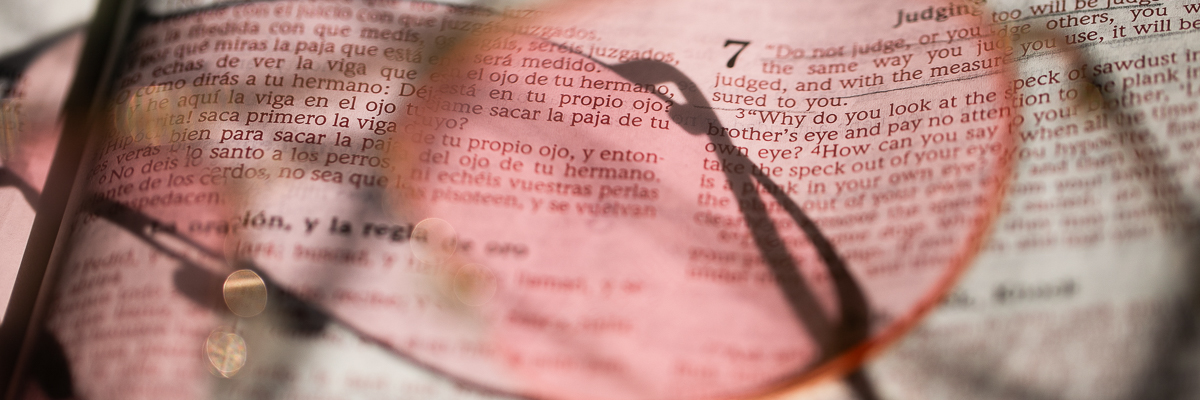
Just because you use Scripture, even in a God-affirming way, does not mean you are using Scripture for life and love, growth and wisdom—and for the sake of God or others.
—Richard Rohr, What Do We Do with the Bible?
Father Richard describes how Jesus read his own Hebrew Scriptures through the lens of love:
Jesus never once quotes from nineteen of the books in his own Hebrew scriptures. In fact, he appears to use a very few favorites: Exodus, Deuteronomy, Isaiah, Hosea, and Psalms. Jesus appears to ignore most of his own Bible, yet it clearly formed his whole consciousness. That is the paradox. If we look at what he ignores, it includes any passages that appear to legitimate violence, imperialism, exclusion, purity, and dietary laws—of which there are many. Jesus is a biblically formed non-Bible quoter, who gets the deeper stream of God’s unconditional love, the spirit, the trajectory of his Jewish history and never settles for mere surface readings.
When he does once quote Leviticus, he quotes the one positive mandate among long lists of negative ones: “You must love your neighbor as yourself” (see Leviticus 19:18). He openly disagrees with Scriptures that emphasize non-essentials and “mere human commandments” that made their way into what are presented as divine commandments (see Mark 7:1–23 and almost all of Matthew 23). Jesus reduces the 613 clear biblical commandments down to two: love of God and love of neighbor (see Matthew 22:34–40).
He omits troublesome verses with which he does not agree, as when he drops the final half-verse from the Isaiah scroll when he first reads in the Nazareth synagogue (see Luke 4:18–19). As if to make the point, he “rolls up the scroll, hands it back to the attendant and sits down.” We can imagine them glaring at him for adjusting the Scriptures. They know the final line of Isaiah 61:2b is “to proclaim a day of vengeance from our God.” Jesus ends with verse 2a, which “proclaims the Lord’s day of favor,” and better portrays the God he knows.
Generally speaking, Jesus makes use of his own Scriptures to teach a message of radical inclusivity, mercy, and justice, and to negate the predominant religious messages of exclusion, religious righteousness, and oppression of the underdog, the impure, and the sinner.
Jesus clearly considers “justice, mercy, and good faith” to be “the weightier matters of the Law” (see Matthew 23:23), and many statements such as this seem to indicate he did have a definite hierarchy of values. As Pope Francis indicated, mercy is always right there at the top of Christian values! Not all Scriptures were created equal in Jesus’s mind, which is a great blind spot for most fundamentalists. Jesus seems to teach that you can only tell goodness “by its fruits” (see Luke 6:43–45) and not just by the action itself. Paul then lists these fruits as “love, joy, peace, patience, kindness, goodness, trustfulness, gentleness, and self-control” (see Galatians 5:22–23).
Reference:
Adapted from Richard Rohr, What Do We Do with the Bible? (CAC Publishing, 2018), 45–48, 50–51.
Image credit and inspiration: Jenna Keiper, untitled (detail), 2020, photo, New Mexico. Click here to enlarge image. Just like the glasses we use to adjust our vision, love is a lens through which to understand and interpret scripture more deeply.


Story from Our Community:
When I realized that the phrase “God is Love” is reversible to “Love is God,” I saw the light. The name “God” immediately conjures up the idea of a person or something beyond understanding. However, Love is here, now, accessible, and within every human. Preaching God is an obstacle for many while preaching Love has no obstacle.
— Peter N.

