In the writings of contemplative writer and monk Thomas Merton, psychotherapist Fiona Gardner discovers how we might once again experience paradise:
The nostalgia for what has been lost remains long after childhood can impel seekers to search both within themselves and out in the world for this lost place, time and state of mind. For Thomas Merton it is the nostalgia for, or intuition of, paradise, and is a longing for a return or restoration to an original state of being which is Eden. For him it is about a reversal of the fall and the separation from God. It is the journey forward to the beginning, “the restoration of that primordial unity and harmony of all creation in God,” and it is part of what it means to be authentic.
For him the journey begins within the self as the false self … that leads to division and alienation from reality, and so the paradise life becomes impossible. It is only through surrendering the false self … that paradise can be regained. To be in paradise, Merton writes, is to recover one’s true self….
For Merton, wishing for paradise involved a devotion to the recovery of innocence. He writes:
The innocence and purity of heart which belong to paradise are a complete emptiness of self in which all is the work of God, the free and unpredictable expression of [God’s] love, the work of grace. In the purity of original innocence, all is done in us but without us. [1]
… The recovery of paradise takes place for the adult in humility and in spiritual nakedness. In other words not self-consciously but as the small child who just is present and just is vulnerable. Merton realized that the recovery of paradise is always hidden in us as a possibility, and is a difficult struggle involving repeated cycles of deaths and resurrections within the psyche, so that the Christian on their journey is both in the wilderness of the desert and in the garden at the same time. [2]
Contemplative practice creates opportunities to return to the ‘enchantment’ of the garden:
Present-moment awareness is about creating a gap in the constant busyness of the mind…. It is through such a clear space that new and creative possibilities are born…. There may be an inner prompting in the midst of a busy life to take stock, perhaps to stop and consider…. The focus is then on the inner desire for that thirst-quenching water of life. In other words to move to a place of renewal and rebirth, where there may be glimpses in adulthood of life beyond the shadow and disguise, and experiences, even if fleeting, of the spirit of the child. One way to start to shift out of the obscured false self way of living is to begin to develop awareness, to awaken the senses, to look, listen, feel, and touch as the small child does—to return to one’s senses. [3]
References:
[1] Thomas Merton, “The Recovery of Paradise,” Selected Essays, Patrick O’Connell ed. (Orbis, 2013), 56.
[2] Fiona Gardner, The Only Mind Worth Having: Thomas Merton and the Child Mind (Cascade Books, 2015), 135–136, 138.
[3] Gardner, Only Mind, 126–127.
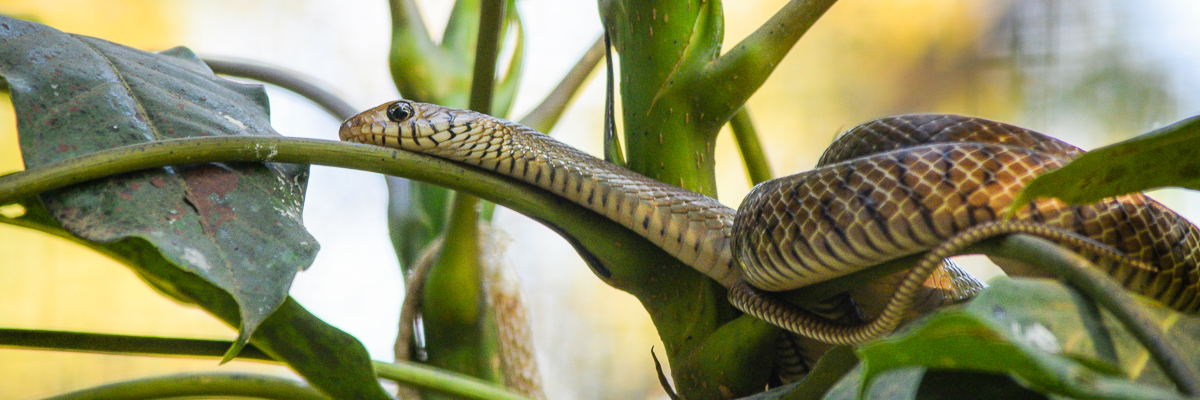
Image credit and inspiration: Abishek Rana, untitled (detail), 2020, photo, Unsplash. Click here to enlarge image. A serpent in a garden invites us to pause. We are reminded that maturing means discerning between venom and challenge. Can we step from innocence into experience—while being held in intimate relationship with God?


Story from Our Community:
A memory of childhood abuse brought me to a halt in midlife. Shame was embedded inside me, and my image of God was tainted. I felt an invitation from God to join God in the desert, to retreat for a season to explore this wound that had been opened. In the “desert,” I spent time with my spiritual director and therapist and engaged in various spiritual practices with God to heal. Meditation transformed my shameful thoughts into belovedness. Centering prayer was like divine therapy. Imaginative prayer showed me how much God loves and accepts me as I am.
—Anne R.

