Carmen Acevedo Butcher: Hi. I’m Carmen Acevedo Butcher.
Brian McLaren: And I’m Brian McLaren.
Carmen Acevedo Butcher: Welcome to Learning How to See.
Brian McLaren: As the podcast name suggests, this podcast is about seeing.
Carmen Acevedo Butcher: Each season we explore some aspect of learning to see, learning to encounter reality, not just on the surface with our eyes, but deeply with our whole being. And this season we’re exploring what it means to see with eyes of love.
Brian McLaren: Thank you so much for trusting us with this time and for being the kind of person who cares about learning how to see with eyes of love.
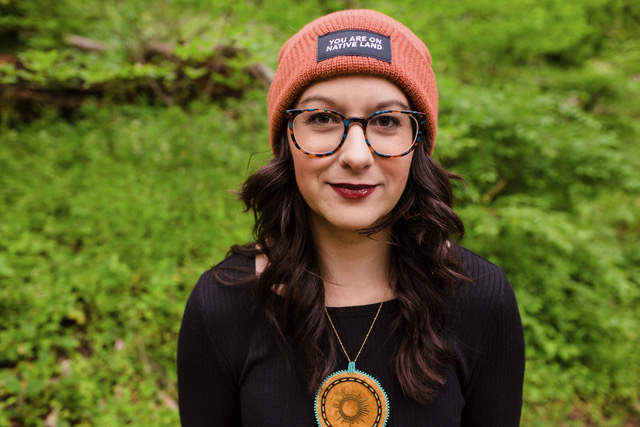
Carmen Acevedo Butcher: In today’s episode, we will be joined by Kaitlin Curtice, award-winning author, poet, storyteller, public speaker, and an enrolled citizen of the Potawatomi Nation, and we’ll be considering the topic, Seeing Ourselves with Eyes of Love.
Brian McLaren: Then, after the interview, we’ll have a brief reflection and then we’ll lead you in a guided meditation concluding with a few minutes of silent contemplation. It is our hope and prayer that after our time together you will feel re-centered on what really matters and that you’ll open your eyes with a deeper sense of love for all you encounter. Welcome everyone to this conversation in this season of Learning How to See. We’re talking about learning how to see through the eyes of love.
And today, we’re talking about a really important element of learning how to see with eyes of love, and that’s learning how to look in the mirror, learning how to see ourselves, learning how to not see ourselves with eyes of contempt or constant self-criticism or disapproval or looking at ourselves through the eyes of someone else who we know does not approve of us, but to try to in some way join with the divine and look at ourselves with that kind of all-embracing love that takes us where we are, but also helps us keep growing and we could not have a better guest for that conversation.
Today, Kaitlin Curtice is with us and Carmen Acevedo Butcher, my wonderful co-host. So good to be with you today. Carmen, before we hear from Kaitlin, how did you ever first hear about Kaitlin? And yeah, I’d love to know your introduction to her.
Carmen Acevedo Butcher: I was reading this article once, and all of a sudden, the person in it was talking about Potawatomi, and I love language. And I was wondering if you could speak to this. It was about the way nouns are verbs and it was the good morning and that was my entry. It was like falling down a beautiful rabbit hole. I’ve been following you ever since, Kaitlin. So, could you share a little bit about that because that is just part of authenticity, right, the language?
Kaitlin Curtice: This is so wonderful because I’ve been just steeped in the power and beauty of language just this morning thinking about it. For indigenous and Gaelic-speaking cultures, this is something I’ve been thinking about and studying a bit. And yeah, our phrase in Potawatomi for the morning is mno waben, and it means that time when the sun is first rising. So, mno waben is the early morning good morning and not the later morning. We have something different for that and moving into the day.
So, it’s that very, very early moment when you see grandfather sun peeking up over the horizon. And I always thought of it as this blessing of it is good when the light shines on you. We’re proclaiming it is beautiful and good that the sun rises again every day and sees us, and I feel that every morning when I greet the sun. On the mornings that I do, it feels like that there is this blessing that just blankets us as humans and it’s such a gift.
Carmen Acevedo Butcher: Mno waben. Is that right?
Kaitlin Curtice: Mno waben.
Carmen Acevedo Butcher: Mno waben. It’s beautiful. Thank you for sharing that. It’s such an entryway into this sacredness of everything.
Brian McLaren: I would call Carmen a language nerd, except that that makes light of something that really is for Carmen and for many of us, and I know this is true for you, language is sacred, it’s beautiful, it’s powerful. I’m recalling Kaitlin, when you and I first met is I remember it, I was asked to speak at a church in Georgia and you sang before I spoke and I was just taken with your voice and your songs. And then we spoke after, and as I recall, you were in a very tender process of taking your indigenous identity more seriously and it just strikes me that I’m sure that was a process of learning to know and love and accept your authentic self in all of its dimensions. Would you care to, well first, tell me if I’m remembering it right, and I would love to just hear you talk about that dimension of your life. So important and beautiful.
Kaitlin Curtice: Yeah, I do remember that night, and I love that you remember. I’m still a singer/ songwriter, but I used to do a lot of singing at events and when we lived in Atlanta, I would sing before events. I know I did that for you. I think Nadia Bowles Webber spoke at that church once. I sang before she spoke, and it was a very tender time. I’m coming up on about nine years since that time and I’ve been learning a lot about these loops that we open and close in our lives and I’m coming to some closing of this nine-year loop. And that was really, I mean in 2014, 2015, I was a young mom and I wanted to write more and there were just pieces of my Potawatomi identity that were revealing themselves to me in deeper ways. Sometimes we just have these very visceral seasons where our identity is showing up to us or our ancestors are speaking to us in very powerful ways, and that was one of those times for me.
And I know when I met you, I was a beginning writer in the publishing world and I had so much that I knew was about to flood my system as far as what I wanted to write, and I was looking for people to hold me and help me work through that, and you were one of the people that did that for me, and that means so much. I mean it really does, Brian, because I knew from the beginning I wasn’t alone and that this very unique journey I’ve had, first of all isn’t so unique because so many people are working through these big questions of identity, but that it was my unique journey and that I could explore being indigenous and trying to figure out how to express my spirituality in the ways that it was showing up in my life. And so, that meant so much to me and was a very, very tender moment in my life.
Brian McLaren: Well, I have loved all of your books, Kaitlin, and I just finished your newest book, Everything Is a Story. And I’m interested in if you could share with us a story or two about the process for you of coming to know and love and accept your authentic self. I think for so many of us, a big part of our early life is trying to live up to other people’s expectations and whether it’s our parents or our religious community, whatever. And learning to maybe stop trying to make ourselves fit other people’s expectations and then try to say, “Well, what’s trying to emerge from the acorn planted deep down inside of me?” So yeah, I’d love to just hear you talk about that.
Kaitlin Curtice: Yeah. I think it’s interesting to be an author because we go from the labels of what we might’ve grown up with in our families or in our communities, and then when you become an author, you have all the labels of who you are as an author. And I think that for the first few years of being an author was really interesting and somewhat difficult for me because people want to put you in boxes because it helps people to categorize things, it helps people to label things. And so, it’s like, what boxes do you check? Even in the bio, what keywords fit who you are? And I remember a few years into being a public speaker and an author, just feeling this need to explode out of those boxes. I was just like, I know I am this or I know I am this, but can I be more than that?
I started writing the Liminality Journal, which is my substack a few years ago in hopes that I could just have a space to explore that with other people, that we have so much liminality and nuance about who we are. Yes, labels, boxes are really helpful, but how do we expand outside of those or how are our identities very multi-layered and they shift and change and how can we hold space for that? So even in my books, because I write from the season of life I’m in, you can see the progression of my spirituality or my ways of being in the world. And with my new book, Everything Is a Story, it just goes one step further into asking how we show up in the world through the stories we tell and the stories that we participate in. And I’ve really enjoyed that process of exploring that.
Carmen Acevedo Butcher: That’s beautiful. One of the things I’ve noticed about this latest joyful book is your connection with the land and trees. So, you’re talking about liminality, how does that factor into this authenticity that allows you to stay open your relationship with acorns and bristlecone pine? And can you just speak to that a little bit because it really resonates with me and I know many people?
Kaitlin Curtice: I’ve had a special relationship with acorns for a few years now. And so, I knew I wanted to find a way to incorporate that and I thought maybe I could follow the framework of an acorn growing into this mighty oak and the way that a story starts small and grows into this, some stories start at the very personal level and they can become entire societies based on a story that we’ve told. And so, I wanted to explore if that could be possible or how that could happen. Trees are such a steady and beautiful grounding part of our world, and so to think about trees, but not just any tree but the oak. The oak is this mighty and beautiful and sheltering presence in the world throughout cultures.
I mean, I write in the book about all the different cultures of the world that view the oak as sacred or all the different ways we use acorns in the world. It’s just such a powerful metaphor and I hope that when people read the book that they, even if I’m not specifically talking about connecting to Mother Earth, that they feel that connection of how important it is to even glean metaphor from the world around us. That an acorn is yes, it is a seed, it’s just an acorn, but it also represents being able to burst out of ourselves, out of the shells that we think we are into something really magnificent and that stories do that as well. I just hope that people can follow that metaphor with me and explore it in their lives.
Carmen Acevedo Butcher: I love that.
Brian McLaren: One of the quotes that I especially loved in Everything Is a Story, I hope you don’t mind me, Kaitlin, reading you from your book, but you wrote, “In finding ourselves, we have to face expectations, the expectations others place on us, whether family or society, and in turn, the expectations we place on ourselves. For years I wanted to travel, work and find my daily rhythms like everyone else, until realized how unsustainable that was. I shared once on Instagram about the realities of being someone with a sensitive body and a sensitive system.
And so, many others shared that they felt less alone in reading that. When we seek to find ourselves and name things for one another for ourselves, a level of fear shows up. Why can’t I just be an extrovert like them? Why can’t I be confident like them? Why can’t my body be strong like theirs? We begin tell a story that harms us, that frames us as the oddity, the thing outside the norm, the one who’s just too much.”
And then you said, “I want to disrupt that story.” And my goodness, as I read that, I think about myself, one of the stories I’m experiencing is the story of aging and the story of health challenges that come with aging. And I found myself having some of those self-critical voices and I find I have to almost break up with that part of myself that wants to be critical and join another part of myself that I think is more what we think of as the spirit of God to look at myself with compassion and with gentleness. And that’s what I felt you were explaining in that paragraph.
Kaitlin Curtice: Mm-hmm. Yeah, this was, well still is, a particularly hard lesson that I’ve had to learn again and again, especially through my public speaking. Because when you travel, there’s so much outside of your control or there’s so many ways you have to stand up for yourself. And I learned very quickly after I started traveling that I get tension headaches and if I don’t deal with them, I get really sick. So, now I know when I do a speaking event, I have to tell them as soon as I’m done speaking, I have to go back to my hotel and be alone for a few hours and I’ll see you next time I’m available. And it was really hard even just to set a simple boundary or to say, “This is what my body can handle. I might not be like other people you’ve interacted with, but this is what I’m able to do right now.” And when I ignore that, it’s bad for everyone, most for myself, but I’m not able to show up in the world the way I need to.
And I think so many of us in the United States, we live in such a grind culture and work hard and do hard and you’ll make it. And even with the book launch of Everything Is a Story, I got shingles because I was pushing so hard that my body said, “No, this is not the sustainable way to do this.” And I’m really grateful because it reminded me, “Oh yeah, I don’t want to follow the status quo of what it means to push like this.” This is not sustainable and it’s not what I want to teach other authors about how we produce our books in the world. I want it to be community led and I want it to be possible for those of us with chronic illness or as we’re aging or our bodies work in ways we may not quite understand or our systems can’t quite handle the capitalist or consumerist society we live in, that that is okay and that we can exist in a different way.
So, I have had to be reminded again and again and I continue to learn, but I really wanted to write about that a few different times in the book. I write about my social battery running low and what we do when our social battery is low. There are just so many lessons we can learn in that, and that is part of loving ourselves and loving our own story and trying to tell a better story about who we are in the world and how we show up.
Carmen Acevedo Butcher: One of the things I noticed that you did in the book is you also model for us, having these mini rituals. For example, when you were on Ho-Chunk land, as you said, and you were speaking at Holy Wisdom Monastery and you said someone had gifted you a pouch of tobacco. And I was just wondering if you could speak to that a little bit because it really shows us how you grow up in this linear culture of the western world, but you’re trying to bring in this cyclical Potawatomi. So can you speak about that just a bit because that was beautiful to me.
Kaitlin Curtice: Yeah. I really befriended this oak tree at the Holy Wisdom Monastery. Yeah, so sometimes when indigenous people, when we meet each other or when I’m speaking places, giving tobacco is a really special gift. It’s one of our medicines and it’s our prayer medicine. So, if you know the language of the culture, you may gift someone who is indigenous, a pouch of tobacco as a thank you for their time, or if you’re asking someone to gift you their wisdom, you might give them tobacco. And so, someone gifted me some tobacco which was really, really kind and I knew the next day I wanted to then gift that to this tree that was just really sheltering me and speaking to me and taking care of me while I was there. And so, it’s just a really important ceremony even just to connect.
In my family, we’re all rock climbers. And so, sometimes when we’re outside climbing, we’ll also take tobacco and we sprinkle it near the rocks and thank the rocks for having us there as guests in their home. And that tree just sprinkling tobacco and thanking them for being there for me and for being there for everyone else who is going to come to that place. It’s a way of acknowledging a relationship with the sacred, with the beings around us in the world. And it’s also a way to bring up those feelings of gratitude just in us that we can connect to our own really deep source and deep wells of care and compassion with the world. And I think even a small ritual like that is so healing. And especially for me, healing, and just any of our Potawatomi practices or rituals are really healing for me because it reminds me of who I am and the people I come from.
Carmen Acevedo Butcher: I just thought that was so beautiful. It reminds me too, I often go to walk in this little marsh near us. It’s about 20 acres of reclaimed land and sometimes when you’re entering into it, you look up and you see egrets flying over and I’ll just pause for a moment and say, “Thank you for letting me be here. And there’s just that it doesn’t take but a moment, but it just reminds me that we’re related and you write about that so beautifully. Do you have advice for us? Do you know, I mean it’s so easy to get caught up in everything and then you write about this in this book and elsewhere. Just advice for those of us who are feeling the stress of things.
Kaitlin Curtice: Something I often tell people is to actually plan in your rest plan in your moments where if you need to get outside and go on a walk, if it’s not working for you to do it spontaneously, then make it a part of your work schedule to rest.
Carmen Acevedo Butcher: Right.
Kaitlin Curtice: If that’s the way we need to frame it, then make rest a part of that and show up to that hour of your time with the intention that you’re making it a part of your day for a reason.
Carmen Acevedo Butcher: Right.
Kaitlin Curtice: So, that intentionality and then also it’s show up with the intentionality but then also show up and be ready to just surrender and hold space for things to be really surprising. That’s the beauty. So much of my poetry is written after I’ve been outside in nature because you’re connecting to these other beings, your kin in ways that are really surprising and these spiritual lessons show up that often you’re not expecting. And so, to just hold yourself open to that is also really important. Maybe we would call that curiosity or maybe we’d call it humility or childlikeness, that we would just be open and surrendering to what we might learn from the world around us.
Carmen Acevedo Butcher: I like that. So, in other words, schedule time for rest and that’s part of authenticity. That’s good.
Brian McLaren: That feeling that you just conveyed, that there’s a beautiful big tree and for you to sit in its shade brings you something, you feel that special presence as a gift. And I think that’s why people like to read your books. I think they feel your paragraphs are like those different branches and the way you write is creating space for people to feel that tenderness and feel that acceptance. And I wondered if we could close our time today with you just reading one of the beautiful poems in your book.
Kaitlin Curtice: Yeah, I would love to. In my culture, my family is Bear Clan. And Bear Clan is often like the medicine keepers of plant medicines and I thought about that for a long time. I love gardening and I love being outside, but I don’t know if I would say that that’s my medicine. And I realized a few years ago and not just realized but wanted to claim it for myself that my words are my medicine and that words to me a poem. I wrote a poem last year about inviting someone to eat the poem that I had written and I’ll publish it eventually. But that idea of actually taking words as medicine because they can be toxins and they can be medicinal for us, and we all know that to be true, right? Like the sticks and stones phrase, we know that words matter. And so, I really appreciate you sharing that with me.
This poem was really meaningful for me. I traveled to Northern Ireland last fall and it was my first time there, but I’ve had some history with different people there and so it was really, really meaningful for me and one thing it taught me was to hold all the parts of myself and to be able to hold what it means to be Potawatomi and what it means to be someone of Celtic descent as well. And how can I bring all of who I am with the complexity that is spirituality in the United States and what I grew up with, this Christianity that we have come to know this colonized Christianity, how do I hold all of that? And of course, I’ve struggled with that much of my life, but especially in my writing life I write about that.
And coming across St. Brigid who was this Celtic goddess and Christian saint that she literally is like the image of liminality, of that portal between different worlds and holding all of that was so encouraging for me to know that I can hold many portals within me, that I can stand at thresholds, that I can be this and this and this and it’s okay and that I can hold the complexities of what it means to be me and what it means to ask deep questions about what I believe and who I am. So, this poem was written out of sitting with the realities of who St. Brigid is and the ideas of who Jesus, this revolutionary person is and what it means to be in community with both of them.
“I’d like to sit down to a long lunch with St. Brigid of Ireland and Jesus of Bethlehem and have a conversation about liminality. I’d like to know about that water-to-wine situation and what it means to rest, how it feels to wander hillsides tending to people’s deepest needs. I’d love to understand how to bring people together at water wells of healing when everyone says we are better apart. I hope they’d ask me how I can be quiet yet full of fire, and what it means for each of us to have lived in the time we lived in. What it means to show up liminally in a world that doubts the power of paradox. I’d like us all to tell our favorite stories of Mother Earth and remember the cultures we come from and the ones we constantly return to, the ones that hold us even when we forget ourselves.”
“I’d like us to grieve the things that aren’t as they should be, colonialism and genocide, oppression and hate, and write then and there, hold each other’s hands and promise to never give up on the power of kinship and belonging. Then, I’d like us to finish our cups of coffee, brush the dust from our shoulders and vow to meet again in the other world, the Milky Way, in the highest heavens, so we can look around together at every moment when the people found each other’s sacred centers and decided to get it right.”
Brian McLaren: Learning How to See will be back in a moment.
Carmen Acevedo Butcher: Kaitlin’s love of language and earth really resonated with me, because lately, I’ve been out at 6:30 in the morning to see the sun fill the dark marsh like a bowl and spill across the reeds, the waters, and the hills. And I love how Kaitlin gives us a word for that in Potawatomi, her organic earth-knowing Indra’s net take on we are the story is so life-giving. In her book, Everything Is a Story, she writes, “Just as acorns are their own beings that have agency but also need the surrounding world to thrive and grow, so, it is with stories. Stories are alive, taking their own presence in the world, they are nurtured every story that grows and becomes even those that are detrimental to us.”
At the beginning of Kaitlin’s book, she includes a poem that she wrote as she reflected on a special moment that she shared, she says with a new friend she had met at a spiritual retreat in the desert some years ago and she offers this beautiful poem to us because she reminds us again, we are the story, the acorn, the seed being born all at once. “A friend once told me I was a lot like an acorn expanding beyond its bud with effortless potential. If an acorn is the beginning, so is a story. And if I am an acorn, I too am waiting to be told. So then are you an acorn growing through your beginnings and making your way into new phases of fullness every day, making your way toward the mighty oak, the elder of all elders. We are stories, seeds, beginnings, the blessed essence of what it means to be human growing seasonally until we find our way back to the holy compost pile. We are the seeds, the stories, the changing landscapes, the longing and hope of all future days.”
And that just meant so much to me and it reminds me of Father Richard’s Cosmic Egg. He says, “To be rebuilders of society, we first need rebuilding ourselves. That a healthy psyche lives within at least four containers of meaning, like nested domes. First is my story, second is our story, third, other stories, and fourth is the story, the patterns that recur everywhere, the wisdom that’s so healthy.” As Kaitlin has reminded us, my story and our story and other stories and the story are all Earth’s story because earth is alive. I can forget this at the computer where I spend a lot of time like I know so many of us do, but I know this truth in my bones when I’m walking through the small marsh near us, 20 acres of reclaimed land and I go out daily if I can. The scenery is always the same and never the same. Taking a photo, I’ll do this often from the same spot on a bridge and every day it’s different.
As I look out across the reeds, out toward the water and hills, I feel that I am part of this living landscape of ducks, blue sky or fog, waves of water, shoreline, waving reeds, oak trees, egrets flying overhead, hawk that just the other day went right past me beside my head as they power toward a tree and gracefully disappear into it and a kettle of Turkey vultures circling and the hard dirt under my feet. That’s home for creatures we rarely see like roly-polies. I then reset and see myself in this landscape part of the whole hole. Where do you see yourself in the landscape? May you look out a window at a beautiful tree or stand by one by yourself or with a friend and see yourself and everyone, all creatures as part of this communal landscape of love.
Brian McLaren: There’s a chapter in the Christian scriptures written by an early Christian leader named Paul. It is many people feel the most profound, most revolutionary and most beautiful passage in all his writings and we invite you now to listen deeply. This is a reading of First Corinthians Chapter 13, a translation by Carmen Acevedo Butcher.
Carmen Acevedo Butcher: “If I speak with the tongues of humans and of angels but do not have love, I am an echoing gong or a ringing cymbal. If I have prophetic gifts and can understand all mysteries and all knowledge, and if I have all faith so I can move mountains but do not have love, I am nothing. If I give away everything I own and if I surrender my body as an offering but do not have love, I gain nothing.”
Brian McLaren: “Love is patient. Love is kind. It does not envy. Love does not brag on itself. It is not inflated by disdain. It is not rude. It is not centered on the separate self. It is not easily angered. It keeps no record of evil. It takes no pleasure in injustice but rejoices with the truth.”
Carmen Acevedo Butcher: “Love bears all things, believes all things hopes all things, endures all things. Love never ends. Prophecies will eventually be discarded. Speaking in tongues will stop and knowledge will ultimately be set aside.”
Brian McLaren: “For we know in part and we prophesy in part, but when we encounter wholeness, the parts will be released. When I was a child, I talked like a child. I understood like a child, I reasoned like a child, but when I became an adult, I let go of childish ways.”
Carmen Acevedo Butcher: “At present, we see unclearly, as in a mirror, but then we will see face to face. Right now, I know imperfectly, then I will know fully even as I am fully known and now remain faith, hope and love. These three and the greatest of these is love.”
Brian McLaren: Today, we would like to focus on the first section of this passage. We’ll read the section slowly twice and then discuss it briefly and then we’ll read it once more. “If I speak with the tongues of humans and of angels but do not have love, I’m an echoing gong or a ringing cymbal. If I have prophetic gifts and can understand all mysteries and all knowledge, and if I have all faith so I can move mountains but do not have love, I am nothing. If I give away everything I own and if I surrender my body as an offering but do not have love, I gain nothing.”
Carmen Acevedo Butcher: “If I speak with the tongues of humans and of angels but do not have love, I am an echoing gong or a ringing cymbal. If I have prophetic gifts and can understand all mysteries and all knowledge, and if I have all faith so I can move mountains but do not have love, I am nothing. If I give away everything I own and if I surrender my body as an offering but do not have love, I gain nothing.”
Brian McLaren: It might sound strange to begin a season about love with seeing ourselves. Isn’t love about unselfishness? Why do we begin talking about self? Well, that’s a great question. I suppose we have to ask what do we mean by selfishness. If we see self as the end and everyone else as a means, I think we’re talking about selfishness. If we see self as number one and everyone else has a lower priority, I think that’s about selfishness. So, I think Paul goes right for that misunderstanding. He uses the word I, that personal pronoun I, eight or nine or 10 times depending on how it’s phrased. And this focus on I, this focus on self is noise, is nothing, is emptiness. And it’s so interesting whenever the I is involved, we’re interested in what I can gain for me and he ends this section by saying, “Without love I gain nothing.” So, it seems to me he starts off by addressing how we see ourselves correctly so that we can love both ourselves and others wisely and well.
Carmen Acevedo Butcher: I love that because I think right there the eye is the small ego, right?
Brian McLaren: Mm-hmm.
Carmen Acevedo Butcher: I also appreciate that Father Richard Rohr says that most people don’t see things as things really are because we see things as we are, which is not to see at all. A person’s, many self-created filters are our self-created filters keep us from seeing with any clear vision. So, we have to get out of our own way. And the contemplative mind is able to see fully and freely more often, which is to be healed and healing of its hurts unforgiveness and the inevitable agendas that always seem to get in the way.
Brian McLaren: So, there’s some way of experiencing a kind of displacement of that little ego where I’m seeing everything in terms of myself, including look how loving I am, right? There’s this desire here to I think help us escape from that kind of self-centeredness and instead of self being in the center, we want to see love move into the center.
Carmen Acevedo Butcher: Love as the true self. I’m down with that.
Brian McLaren: Beautiful.
Carmen Acevedo Butcher: We would like to invite you to listen once more to this brief section and then we’d like to invite you to respond with a request or a desire. It might be a prayer where you ask for help.
Brian McLaren: You might find yourself saying, “Help me not to see myself as separate from others. Help me not be centered in myself, my ego, my separateness, but help me be centered in my connection, my belonging, my interwovenness with all creation. Help me not see myself as the end and others as the means, but to see love as both the end and the means. You might pray help me not see myself as the star of the show and others as supporting cast members, but help me to see us all as supporting cast and the star is love itself.
Carmen Acevedo Butcher: “If I speak with the tongues of humans and of angels but do not have love, I am an echoing gong or a ringing cymbal.”
Brian McLaren: “If I have prophetic gifts and can understand all mysteries and all knowledge, and if I have faith so I can move mountains but do not have love, I am nothing. ”
Carmen Acevedo Butcher: “If I give away everything I own. And if I surrender my body as an offering but do not have love, I gain nothing.”
Brian McLaren: We now invite you into a brief period of silence and we invite you to let this wisdom simply be present to you and we invite you to be present to this wisdom. We’re not seeking so much to grab a hold of love, but by releasing and by letting go to let love take hold of us. Thanks for investing this time in Learning How to See. We trust that each episode will send thousands of us back into our daily lives with a little more skill and a little more depth in seeing everything and everyone everywhere with eyes of love.
Carmen Acevedo Butcher: Big thanks to Corey Wayne, Dorothy Abrams and Vanessa Yee, who produced Learning How to See. Thanks to April Stace for her musical support. This episode was edited and mixed by the team at Sound On//Sound Off. To learn more about their work, visit soundonsoundoff.com. Thanks to the Center for Action and Contemplation for making Learning How to See possible, and special thanks to you for your investment of time.