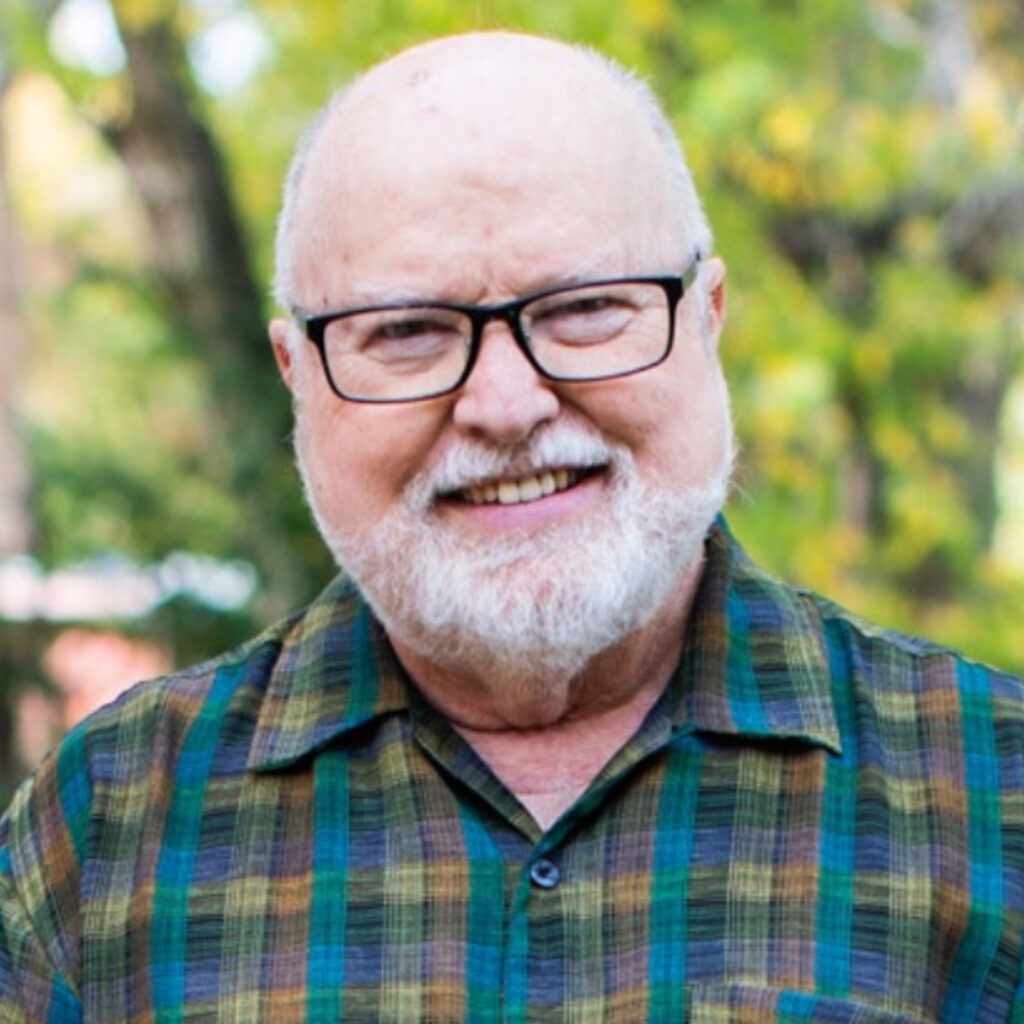
Jim Finley: Greetings. I’m Jim Finley.
Kirsten Oates: And I’m Kirsten Oates.
Jim Finley: Welcome to Turning to the Mystics.
Kirsten Oates: Welcome everyone to season 13 of Turning to the Mystics, where we’ve been turning to Thérèse of Lisieux and her story of a soul. And I’m here with Jim, and we’re so delighted to be welcoming our special guest, our dear friend Father Richard Rohr to the podcast. We’re excited to have him here because we know that Thérèse is one of his favorite and most influential mystics. But before we start, for those of you who don’t know Richard, he’s the founder of the Center for Action and Contemplation, he’s a Franciscan Friar and ecumenical teacher, and bears witness to the deep wisdom of Christian mysticism and traditions of action and contemplation. Father Richard teaches how God’s grace guides us to our birthright as beings made of divine love. Richard is the author of lots of books, including The Universal Christ, The Wisdom Pattern, Just This, and one of my favorites, Falling Upward.
Well, we’re so thrilled to have you with us today for turning to the Mystics, Richard. Welcome.
Richard Rohr: My privilege, thank you, on one of my favorite and most important subjects, Thérèse.
Kirsten Oates: That’s why we wanted to have you on this season. We’re excited to be able to learn about that. I thought we’d start with having Jim just share a little bit about how he approached Thérèse this season so we can all be on the same page with the listeners.
Richard Rohr: I’d love to hear that. Great.
Jim Finley: I shared with people that I was introduced to Thérèse at the monastery. Thomas Murton had a devotion to Torres. I was introduced to her. I was quite taken by her. And he also gave me a relic of her, some whists of her hair. I used to keep it pinned over my heart under my scapular. I had to give it back when I left, but I had a devotion to her. But what struck me about her, I want to indicate three things to give you an idea of the tone. The first thing that strikes me when you read the story of a soul is that she wrote the story of a soul under obedience by the prioress who was her older sister, and therefore, unlike Teresa of Ávila and John on the cross, she wasn’t writing giving us directions or suggestions. She was writing in a very personal, self-disclosing way of her experience of herself in the presence of Jesus. So I think when we read her, it helps us sit with where we are within ourselves and the presence of Jesus. It’s so intimately personal.
The next thing is for a young woman, she says these stunningly insightful things. To single out two things, one is she says in The Story of a Soul, she says it’s very rare to find people who aren’t concerned about their inabilities to get past their shortcomings to find God, instead of placing their confidence in God who’s infinitely in love with them in the midst of their shortcomings.
Richard Rohr: Yes, yes. That’s the heart of it. Yes.
Jim Finley: Yeah. And the next thing she said, which is similar to the same thing, she’s so aware of her limitations, the little way, how little she is, and so she says, “I’m so little in terms of reaching the sacredness of who you are. Therefore, you’re going to have to be my sacredness. And in Jesus, you are my sacredness because you came to me and gave me your very self and merged it with my very self.” And so it raises the whole question too about the fact she’s made a doctor of the church, she raises a deep question about what the church is, like the intimacy of it. So that was the tone that I set in the talks.
Richard Rohr: Wonderful. Thank you.
Kirsten Oates: Richard, I’m curious about when you were first introduced to Thérèse.
Richard Rohr: Yes. I picked up a book, a very small one in my noviciates library. Your novice year is your first year, same year that Jim was a novice right down the road in Kentucky. I was in Cincinnati. I don’t think it’s a well-known book, nor by a well-known author. Father Liagre, a Holy Spirit Father, he summarized her teaching so simply and so well. I remember closing the book somewhere. Now remember, I’m 19 and looking for inspiration, guidance, and I closed the book saying, “This changes everything. This is not what my other professors are saying.” This was the year before Vatican 2 began or two years before, when if we’d be honest, a religious life was very legalistic, very ritualistic, and many of my professors were legalistic, ritualistic. What else could they be? That’s all we were given.
And have this young French woman with such calm inner authority say, “You know what? It isn’t true.” We had a word you’re probably not that familiar with called Janzenism, and the French church was especially known for it, petty sentimental legalism by some theologian called Cornelius Jansen. He just did untold damage to the spirituality of the French church, and she did a broad side without trying to, just being guided by love. So that changed everything, and I could say it was her underlying spirituality complemented by Francis and Franciscanism that got me through the seminary. It wasn’t the direct teaching I was being given by the professors, which was tainted with Jansenism, legalism, basically the underlying premise, “If you’re perfect, if you do it right, God will love you.” That was the underlying assumption, which is false.
Kirsten Oates: Well, I love that story. One, our listeners may not know that you and Jim are only three months apart in age.
Richard Rohr: Yes.
Kirsten Oates: Yeah. So that you entered the religious life at exactly the same time.
Richard Rohr: Exactly the same time.
Kirsten Oates: Yeah.
Richard Rohr: He looked much younger. He has his hair.
Kirsten Oates: Yeah.
Jim Finley: Yeah.
Kirsten Oates: And that you both found Thérèse in that early phase of your journey and she was very significant to both of you, so yeah, that’s beautiful. So Richard, how did you navigate things then with developing this underlying sense of Thérèse and Francis in the midst of this more legalistic experience?
Richard Rohr: Sensibly, common sensingly knew she was right, and trusted her against my legalistic professors. Not all of them were, but enough of them were. Most confessors were legalists, and I just quietly, “Okay, they’re going to say that, but I know it’s not true.” And that was a good common sense given me by my German farm parents, to trust common sense. There was a book written by a Carmelite to describe the teaching of Thérèse, and the title, maybe you’ve seen it, Jim, was The Love that Keeps Us Sane, Mark Foley, and that said it in a word. A science of love is what she called it. It keeps you sane. I’m sure a lot of the insanity of our present country is more than anything else due to a lack of love. When you can’t trust that there is love that can be relied upon, we all go insane. This is happening to us. It kept me sane during the whole seminary, the next nine years.
Kirsten Oates: I’m curious for both of you because you were 19, very young when you were reading her, but she was writing that book at the same age.
Richard Rohr: At the same age.
Kirsten Oates: Yes. So I’m curious if she really spoke to your true experience of how you’d experienced God prior to coming into the formal religious life, because she’s talking about her childhood, but from this viewpoint of a young woman. So I’m curious about that experience of reading her and did she really speak to your own knowledge and felt sense of God in your life and Jesus?
Richard Rohr: Yeah, it was her supreme common sense. I’m repeating myself.
Kirsten Oates: Yeah.
Richard Rohr: She just was … So many lives of saints were so uncommon sense. We used to, in the rec room, make fun of them, the intense asceticism. Where does that come from? All this premise based on, unless you suffer, God cannot love you is terribly misplaced.
Jim Finley: You know what I think too about her being so young, and we were so touched when we were so young? I know, Richard, your things about the first half of life and the second half of life and the third half, the wisdom part, the wisdom year. I think that what sometimes happens, when we’re still young in the first half, we’re granted foreshadowings of inner wisdom that transcend the years.
Richard Rohr: That’s good.
Jim Finley: It isn’t that we’re not young, but there’s a certain depth of clarity, like a wisdom depth that she had, and so when we read her, it awakens that depth in us. So I know when I was in the monastery with Merton and studying metaphysics and so on, I was very aware of how young I was, but I was very aware of the inner clarity of the depth that I was being immersed in in the silence of the monastery, and she was immersed in that depth.
Richard Rohr: Could it be that’s what she meant, Jim, by spiritual childhood?
Jim Finley: Yes.
Richard Rohr: Was that her language for the same thing?
Jim Finley: Yeah, the child, Jesus. It is.
Richard Rohr: Because it wasn’t childish at all.
Jim Finley: No. Unless you become as a little child, you shall not enter the kingdom of heaven. It’s very childlike.
Richard Rohr: Like, yeah.
Jim Finley: Namely, it’s just open-faced and the love that can’t be explained.
Richard Rohr: Exactly.
Jim Finley: And you walk by it and you live by it, and she embodies that.
Kirsten Oates: This was my first time going deep with Thérèse, and what I loved about her is it took me a while to attune to her simplicity. She’s so simple, but it’s so immediate. It’s so pure, relationally connected to God, it’s such a purity. Her little stories seem quite simple, but then this deep connection to God’s presence, which is palpable in the text.
Richard Rohr: Do you remember the story of standing at the bottom of the staircase and lifting her little foot?
Jim Finley: Yeah.
Richard Rohr: I was able to stand at that staircase. I looked down at that and I said, “Here, she had her image.” For those of you who don’t know, she pictures God as Father standing at the top of the staircase, beckoning her up. “Come on, come on, come on.” And her little leg is so tiny, it can’t even get to the first step, but she keeps trying like a little toddler would, and then at a certain point, God runs down the steps and carries her up. For my 19-year-old mind, that was my first intimation of a good, serious metaphor for how grace works. All God needs is our desire and he does all the rest.
Jim Finley: It’s almost like she says this in a stunningly simple way. She says these intimately deep things, so when we hear the story, our heart knows it’s true. It’s so disarmingly simple, it resonates with us and it helps us get past our own thought patterns, like standing by what our own heart knows is true. She helps us find our way to ourself. She does that over and over again.
Richard Rohr: Over and over.
Kirsten Oates: I also think that what’s subtle but so true about her is she’s so steeped in scripture, but not as a proof text or something to really understand. It drew her into a really deep relationship with Jesus and a way of really guiding her own life and understanding the world and understanding reality, and I was so touched by the way she lived out of the scriptural stories and connection.
Richard Rohr: Very true. She loved scripture, and yet she never used it legalistically or literally even. It was always spiritual metaphor for deeper things.
Jim Finley: I also think about her in scripture, like in the Template of Lectio Divina, that when she read scripture, when she heard Jesus say, “Fear not, I’m with you always,” she said that in those words, she knew it was the deathless presence of Jesus telling her not to be afraid. That’s scripture. The text is the revelation of the embodiment of the presence of Jesus. She was in the choir, the monastic choir with the Carmelites, and when I was in the monastery channeling the Psalms back and forth, you get that same sense in the Psalms. It’s God’s voice, so your own mouth is pronouncing God’s own voice, like the intimacy of scripture, like you’re caught up in the living word of God speaking itself to your heart.
Kirsten Oates: Well, Richard, I’d love to hear about your visit to the … You visited where she lived and the convent where she died. Is that right?
Richard Rohr: Yes. It was in this very month of April, five years ago, something like that. A wonderful Carmelite priest invited me on a pilgrimage with just five people who he felt were ready to understand Carmelite spirituality. When Thérèse was there, there was one bathroom on each floor for 50 nuns or something like that. He used his good American ingenuity and fundraising to put in more bathrooms, and so they love Father Bob, and when he came, he got whatever he wanted. Well, what he wanted. He told him, I found this out afterwards. This isn’t true, but he said it. “I’m bringing a famous priest and I’m sure he wants to see beyond the usual tour, especially to the room where Thérèse lived and the infirmary where she died.” So I got that tour, and Sister Claudette, a Canadian English-speaking nun, took us on the tour.
She had to open the door. It hadn’t been entered for some time, the infirmary room, and we lined up to hear the whole story, we’re looking at the bed where she died, and then Claudette told me to open the window. I had a little difficulty with it. It was a French window, built a little different than ours, but I finally got it open. So I was standing between the window and the rest of the group. What we all noticed at the same moment, there was a rather large butterfly between the screen and the window. How it got in there, couldn’t figure out, but sister said, “Father, let him out. Let him out.” So, okay, I eagerly started playing again with the window I didn’t understand and got it finally open, and the butterfly flew out into the garden that Thérèse looked upon.
I don’t want to make myself or this experience more important than it really is, but for me, it was transcendent. I felt I was levitating as that happened. I put my hands on the windowsill to stabilize myself because I thought I was going to fall, and the others are standing in awe behind me. We were all touched. We knew something transcendent was happening. I stood there, I don’t know how long after the butterfly left, and I turned around and looked at them and said, “What just happened?” None of us knew, but all of us knew. The way we interpreted it was that I should use my teaching role to spread Thérèse’s message. It was the release of the butterfly.
Then the sister ran up to me. She was in a full Carmelite habit. You have to have been raised by nuns the way I was to know that often, the habits created a little secret chamber between the nun and the student. They could whisper little things to you, little threats or little promises. She came up and she said, “I don’t know who you are, but I knew I was supposed to bring this today.” She got inside her habit and pulled and offered me this little relic. I know only Catholics are impressed by relics. This is called a first class relic, which means it’s part of her body. She said, “I’m the archivist, and I don’t know why I went to the archive this morning and felt the impulse to bring this, and now I know it was to give it to you because you clearly have a relationship with Thérèse.”
So she said, “Put it in your pocket.” Nuns were so authoritative, you didn’t disobey them. “Don’t tell the others I gave it to you, and when you’re alone later today, open it up.” “Okay, sister. Thank you.” And later in the day when I left the group, I opened it up and got not this whole container, but just the little inner. So it’s called a first class relic, which means it’s part of her body, and here it is in my little living room in New Mexico.
Kirsten Oates: Wow. Yeah.
Richard Rohr: Yeah.
Kirsten Oates: What an amazing story.
Jim Finley: Did you share too that when you were leaving, you looked up and you saw a big picture of Thérèse and there was a butterfly in the picture?
Richard Rohr: Well, you got it slightly off.
Jim Finley: What is that?
Richard Rohr: From Lisieux, we went to Avila in Spain, and the first little antique shop we walked into, there hanging on the wall in this antique shop was a replica of a little plaster of Paris statuette of a yellow and orange butterfly. And Father Bob pointed at it and said, “Richard, look at that.” I said, “Oh my God, that’s exactly what it looked like. I’m going to buy it.” “No,” he said. “I’m buying it for you.” Well, I had to take down much of my room a few weeks ago, but I still have it.
Kirsten Oates: Wow. I love that story, Richard, because one of Thérèse’s most profound teachings came when she was out in nature and saw the flowers, and so she was very attuned to God’s presence woven through nature and she was able to learn from God in nature. And so the fact that you were looking out the window, that something from nature arose and connected with you is very like her own connection.
Richard Rohr: And her spiritual mother, Teresa of Ávila, also used the butterfly in particular as a metaphor for the soul. She used it frequently, so I just felt so touched those days. I didn’t come down for weeks.
Jim Finley: You know what also is touching about that story? I love stories like that, is that on the surface, such a simple thing as letting a butterfly out the window is a stunning experience of God. And I think Thérèse, the little flower, saw the stunning oneness of God in the simple immediacy of things.
Richard Rohr: That’s right. You got it.
Jim Finley: The miraculous quality that washes over us this way. Yeah, it’s true.
Richard Rohr: Thank you.
Kirsten Oates: I’d love to hear as you tell that story now, and you had this mission to spread the science of love, Thérèse’s science of love, what do you reflect on now as you think about that time and where you are in your life now?
Richard Rohr: Well, it certainly prepared me for my last years. Things, to be honest, get darker. As you know, you’re nearing death. You want to evaluate, did I do anything right? Thérèse’s teaching freed me from that over self-analysis, that over self-criticism, which I see so many of my peers saddened by. Their final years are not happy. They’re sad. Not sad in a good way, in an unhealthy way. She continues to be a central guide.
Kirsten Oates: We did talk in the podcast about her death in the infirmary. Can you tell us a little bit about that room? How big was it? Was the view beautiful? What were her last months like?
Richard Rohr: Well, it was like a typical monastic cell, a rather small room, the bed took up half of the room. There was a little chest of drawers to the left. I was by the window and between the window and the bed, and then once you got the shutter open, you looked out at the garden. The most striking thing, which sister pointed out, she says, “Now look out and you’ll see there’s a large hedge row on the edge of the garden. It’s still there. A huge part of it is dark. It’s where the plant didn’t grow or didn’t develop.” She said Thérèse used to look at that hole and she says, “That’s me. That’s me.” It was during one of her dark periods where she didn’t have the gift of consolation or understanding. She had to live by confiance, confidence, purely confidence. That was one of her favorite words, confidence in God’s love, but she couldn’t feel it or experience it. It was like that hole in the hedge row, but it’s still there. It’s still there.
Jim Finley: Turning to the Mystics will continue in a moment.
Another dimension that added to that, I think, about the end of her life, with tuberculosis, she was literally suffocating, and they didn’t have any respirators and so she was constantly gasping for oxygen. And so she said, “It’s hard to describe the world that I live in.” She said, “I still believe God loves me, but I can’t feel it.” So like she’s in the dark night of the soul, in this state. Until the very last moment of her death, it was this ecstatic moment. She fell back in the bed and died. It’s another stunning aspect of her life.
Richard Rohr: How hard to have confiance.
Jim Finley: Yes. Yeah, yeah. And when you’re lost and yet, yeah.
Kirsten Oates: What do you think we can learn from that? It’s quite amazing to hear that a saint experienced this loss of God’s presence. What do you think we learn from that in our day-to-day journey?
Richard Rohr: Faith isn’t faith, it comes to me now anyway, until it’s a free action. It isn’t motivated by childhood teaching, social pressure, church sermons, and those all aided you to get there, but it’s utterly free. I don’t have to trust this love, but something gives me the power to do just that, to trust that love, infinite love, which Jim speaks of so well. Infinite love is the source, infinite love is the goal. Infinite love is the in between. Infinite love is the energy, the love that keeps us sane.
Jim Finley: Yeah. The big thing about Thérèse too, and all the mystics really, is that when she sat with Jesus, the whole mystery of Jesus on the cross, in the agony of the cross, “See, my God, my God, why have you forsaken me?” That in Jesus, God is won with us in our loss of the ability to experience God and God’s won with us in that loss. “And then into your hands, I command my spirit.” He gave himself over to the God he could no longer find. She was so infused with that mysterious sense of a love that transcends and is beyond our ability to feel it or not feel it. That’s why God has a presence that unexplainably protects us from nothing, even as God unexplainably sustains us in all things.
Richard Rohr: Sustains us.
Jim Finley: Yeah, unexplainably, even in death itself and beyond, and she embodies that radical sense of love.
Kirsten Oates: And not just in her own being, but the way she intentionally tried to still be a loving presence to the sisters. It’s what you read in Story of a Soul, how when the sisters would visit her, they loved to visit her because she made them feel so good. She’d smile or make them happy, so there’s something about living intentionally in relation to the love that you’re not feeling inside, but you have the confidence in.
Richard Rohr: One of the sisters whom she had the hardest time loving, you probably know this story, read The Story of a Soul after Thérèse was dead. She said, “Oh, here I thought I was her favorite.”
Kirsten Oates: Because she said she was a test for her patience.
Richard Rohr: The ones I had a hard time loving. “Oh, I was Richard’s favorite.” No, they probably knew my displeasure.
Kirsten Oates: “Yeah. How amazing, because she talks about her as someone who she tried her patience, but how she was learning how to be a loving presence, and that was part of the science of love was to do small things with great love, even with people that triggered you, using our current language.
Richard Rohr: If you haven’t discovered infinite free love, you don’t end up a happy nun or monk. At the end of your life, you often, and I’ve met enough of them, you often turn bitter.
Kirsten Oates: Hearing about the one bathroom on the floor, I can see how she would have had a lot of opportunities to practice patience and infinite love, sharing one bathroom with 49 other sisters.
Richard Rohr: Well, two bathrooms, one on the first floor and one on the second.
Kirsten Oates: Oh, wow.
Richard Rohr: It’s unbelievable.
Jim Finley: I like, Richard, when you say that the thing is not enough old people are elders. They’re just grumpy old people. That’s what you say. The fact you’re old doesn’t mean you’re an elder.
Richard Rohr: No, no. It’s sad to see how many unhappy old people there are. If you haven’t met the love that keeps you sane, you’re insane, in one way or another.
Kirsten Oates: And do you feel for both of you that Thérèse is still playing a role for you in your life in that way?
Richard Rohr: Oh, yes. I look up at this on my bookshelf frequently, asking for her guidance and inspiration. I know that’s probably too Catholic for a lot of our listeners, but-
Jim Finley: The place where I write every day, I keep her picture, and even on the front of the book, The Story of the Soul, the photograph of her face, she’s got incarnate love in a way, just the presence of her face, her deathless presence.
Richard Rohr: You know, I said to some of our listeners in a talk yesterday that the best way I can summarize the difference between the Catholic worldview and the Protestant worldview is the Catholic who developed for 1500 years before the printing press, we learned to recognize God, to respond to God through things, touchable things. Protestantism, and there’s a gift to that too, came to rely upon words, over-rely, because words do not mean experience. Words do not mean I know it. You just keep quoting the words. Now, we have the best of access to both now, things, incarnation. First of all, words to affirm the incarnation. But I see it in so many of the Protestant trained people on our staff who come to the center. If you were raised exclusively Protestant, there’s an over, forgive me, an overreliance upon words, and words are not experience.
Kirsten Oates: Because that’s reinforced by the whole Western culture, I think, too.
Richard Rohr: Oh, yes.
Kirsten Oates: Yeah.
Richard Rohr: Became the enlightenment, which was the love of words.
Jim Finley: You know another thing I think is significant here, as I was reading the Catholic theologian, Karl Rahner, and he points out that when Luther, with the reformation, it wasn’t just a badly needed reform of the Roman church. But when he opened the scriptures, he was deeply influenced by the enlightenment period of science, and he saw the Bibles revealed facts like proof texts. And then Richard, you point out, the Catholic Church joined in with the counter reformation and they had their proof texts. And then Karl Rahner said, “What’s missing is mystigody, the mystery that can’t be explained, which is God, but it can be realized.”
Kirsten Oates: Yes. And then you have someone like Thérèse who goes out into the garden and receives one of the deepest, most helpful teachings from God directly through creation. I think that’s what’s … For me, reading Thérèse deeply for the first time, it took a while for me to allow the simplicity to break through. When I first started reading her, I was-
Richard Rohr: It’s unnerving at first.
Kirsten Oates: Yeah, exactly. And it doesn’t sound highfalutin and intellectually profound, but it’s got this experiential profoundness that if you allow it into your heart, it really can bring you into that experience as you read her.
Richard Rohr: Beautiful.
Jim Finley: You know what else I think too about Thérèse is the light shines in the darkness and the darkness grasp it not. So we can’t grasp, the finiteness of ourself can’t grasp the light, but we can unexplainably realize what we cannot grasp, that God touches our heart with shimmers of the unexplainable of God’s oneness with us as God’s beloved, and Thérèse embodies that.
Kirsten Oates: One thing I’m curious about that really struck me in learning about her was when she had that experience, the lights were all out. She coughed and she felt something in her mouth, but she had to wait until morning to know what it was, and this was when she discovered the blood in the hanky. But she said before she went to sleep, “I thought perhaps I was going to die, and my soul was flooded with joy.”
Richard Rohr: Wow. I don’t remember that. That’s good.
Kirsten Oates: Yeah. And then she woke up in the morning and the hanky was full of blood. In the light, she was able to see that the hanky that she’d coughed into was full of blood and that she was indeed on her death path. So I’m curious what you make of that, that the first experience of knowing she might be about to die was joy.
Richard Rohr: Well, it’s just evidence of a highly transformed human being who lives in the light of eternity, not in the light of tomorrow. That’s what’s killing our culture. It’s all about present rewards, present response, present money. It just, it doesn’t last for the soul. It’s not food for the soul. It has to be food for eternity. I don’t know how we’re going to reteach that to a secular culture. It’s not going to be easy.
Jim Finley: I heard once, somebody said, “This may be a valley of tears, but we sure don’t want to leave it.” Even though we believe theoretically that heaven is infinite union with the infinite love of God, I think I can wait on that one. It’s interesting how we believe it and we don’t take it to heart what we’re saying, that we’re going to cross over from veil to unveiled infinite union as our destiny, and she was so taken by that. I like Teresa of Ávila says, “I used to pray to ask God to let me die so I could go to heaven.” And then she said, “I realized the only reason I’m not dead yet is God doesn’t want me to be dead yet. So I want to live as long as God wants me to live, and when the time comes to die, I want to die.” And I think Thérèse has that same spirit about her.
Richard Rohr: Very much.
Jim Finley: Yeah.
Kirsten Oates: There’s an authority to their life well beyond circumstance, the day-to-day circumstance, and that authority is completely trustworthy and completely loving towards them. Richard, I read somewhere that you said that Thérèse helps you with your Enneagram oneness.
Richard Rohr: Yes, because ones are sick perfectionists, because it’s perfection by our own self-centered definition of perfection, and so you’re always defeated. You define the rules and then you don’t live up to them. Thérèse is the best counterweight to any theology of our spirituality of perfectionism. She was my liberation. I just didn’t believe it anymore. It isn’t true.
Kirsten Oates: And I’ve heard you, Richard, talk about you welcome a daily humiliation.
Richard Rohr: Yeah.
Kirsten Oates: Did Thérèse inspire that?
Richard Rohr: At least one…
Kirsten Oates: Yeah.
Richard Rohr: One a day, and some days, I get more than I asked for.
Kirsten Oates: And how does Thérèse inspire you about being open to a daily humiliation?
Richard Rohr: It’s almost like Thérèse peeking at me. “Okay, here it is. Let’s see how you handle it.” The world isn’t shaped the way you want it to be shaped. As I’m in this last half of life, I feel I’m called and sometimes enabled to forgive everything, everything for being what it is. The president, the country, our politics, our wars, our treatment of the immigrants and the poor, how do you see that, hear that every day if you can’t forgive it? You turn very bitter, and that’s much of our country right now.
Kirsten Oates: And you forgive it because you know God forgives it?
Richard Rohr: That’s it. If God can tolerate this, I guess I can too, by God’s grace.
Jim Finley: “Father, forgive them. They know not what they do,” Jesus said on the cross.
Richard Rohr: And it’s forever the same prayer. That’s right. They know not what they do, but it is heartbreaking to live in this insane time where so much is so wrong, so crazy.
Kirsten Oates: I love that about forgiveness. Richard, would it be true to say that you could almost replace … You started the Center for Action and Contemplation? You could call it the Center for Action and Forgiveness, that you’re taking action out of this forgiven state.
Richard Rohr: Thank you. That’s excellent.
Jim Finley: Yeah. That’s right.
Kirsten Oates: Forgiveness doesn’t make you passive.
Richard Rohr: Yes.
Kirsten Oates: Yeah. But you want to take action.
Richard Rohr: Is action in practice, forgiveness. To know it and to see that it’s not perfect yet is to be called to forgive it, but I don’t know how else you find happiness.
Jim Finley: I think Thérèse saw that in Jesus too, is that Jesus says in the presence of God, you’re already infinitely forgiven, and your suffering is you can’t yet accept the forgiveness that you’re in. You’re still holding on to the authority of the shame you feel about a limitation rather than let the gate fly open and let this infinite forgiveness take you to itself and your limitations.
Richard Rohr: In Jesus’ life, the way he forgave sin, which is a phrase we use so much, is by living in solidarity with it. He’s always eating with sinners, he’s always identifying with sinners. That’s a very subtle way of forgiving it. It’s not some instrumental action or ego te absolvo of the way we thought sin was forgiven. Sin is most deeply forgiven by living in solidarity with the imperfection of everything.
Jim Finley: That’s true.
Richard Rohr: I’m still living my life trying to do that. Some days I succeed, and then I’m happy.
Jim Finley: There you go.
Kirsten Oates: Jim loves your humility, Richard.
Jim Finley: Yeah.
Richard Rohr: Most days I don’t succeed, and then I’m unhappy.
Jim Finley: Yeah. You know what’s interesting? So honest to say that, I don’t succeed, but the very fact I don’t succeed, deeply accepting that I don’t succeed, I taste God’s infinite acceptance of me.
Richard Rohr: Very good.
Jim Finley: And I think that’s Thérèse too.
Richard Rohr: Of course.
Jim Finley: Yeah.
Kirsten Oates: I was struck by the fact that Thérèse was able to choose her own name when she went into the convent, and so she was Thérèse of the Child Jesus and the Holy Face, how that really spoke from her heart. She really felt that in her heart. Did you get to choose your name, Richard, when you went in?
Richard Rohr: Oh, yes, but it was Alexander, The Strong Man. Normally, we had a choice among the most recent friars who had died, and Father Alexander had just been hit by a bus the week before I joined. So they said as I knelt there piously in my new habit, “Hence forth, Frater, brother, you will be known as Friar Alexander.” I had that name for six years.
Kirsten Oates: Whoa. Wow. Friar Alexander.
Richard Rohr: And then Vatican II, which reformed everything, told us our name in Christ is our baptismal name. We don’t need another one. So I said to my parents, “What do you want?” They said, “Oh, we named you Dicky.” My father was Richard, I was the junior, so I went back to Richard. Yeah.
Kirsten Oates: We played around in the season, Jim and I, of inviting everyone listening. If they could speak from their heart and choose their name like Thérèse did, Thérèse of the Child Jesus, what might they choose their name to be?
Richard Rohr: That’s good.
Kirsten Oates: Yeah. I wonder if something comes to mind for you, Richard, if you were to choose your name now.
Richard Rohr: I wonder what it could be now. It doesn’t come to mind.
Kirsten Oates: Yeah.
Richard Rohr: No.
Kirsten Oates: I hear you as Richard the Gazer.
Richard Rohr: Oh, well, presently, I was on my porch here gazing yesterday.
Kirsten Oates: Wow. And the gazing has a spiritual connection?
Richard Rohr: Prayer has become, and in morning prayer, I spoke to the staff or the attendees. I wish I could gaze as well as Mary Oliver. You don’t get lost in theology and denominationalism and piety. Just, she was an expert gazer, looked at everything till she could love it. Henry David Thoreau did the same thing.
Jim Finley: When we were in Albuquerque, we went out and visited you in your home, and you and I talked about the third half of life. About eight people came out with us and so on, and you were lying back in this cot. Your dog was on your lap, and you said to me, you said, “I’d lie here for hours a day looking out, gazing at that tree.” And he said, “The tree is God, like the divinity.”
Richard Rohr: Sounds like pantheism.
Jim Finley: Panentheism, yeah.
Richard Rohr: But it’s panentheism, yes. Right.
Jim Finley: That incarnate infinity.
Richard Rohr: Which is fully orthodox.
Jim Finley: It is.
Kirsten Oates: Yeah.
Richard Rohr: Yeah.
Jim Finley: I like Thomas Aquinas says, “God’s more a tree than a tree could ever possibly be.”
Richard Rohr: Ooh, I like that.
Jim Finley: Because God’s the infinity of trees.
Richard Rohr: I’ve never heard that quote.
Jim Finley: Yeah. Trees are what God eternally contemplates trees to be in the word, “So let there be trees.” So it’s the divinity of tree, the God’s body coming out as tree.
Richard Rohr: That was the one idea I hoped my book, The Universal Christ, could communicate. And a lot of people got it, God bless them. It’s good. They’d experienced it. Yeah.
Kirsten Oates: They experienced it. It hadn’t been confirmed, so it just gave them permission to let it flow all the way in. Yeah, that was a beautiful gift, Richard. Yeah, highly recommend that.
Richard Rohr: There, I got my name, The Permission Giver.
Jim Finley: There you go. I like … That’s good.
Richard Rohr: I hope I’m giving a lot of permission, as if they need it from me.
Jim Finley: In spiritual teaching, like your book, when people read it, as they read it, their heart knows that it’s true. Then it helps them put words to what their heart knows is true.
Richard Rohr: If it does, we have confirmation, the speaker and the spoken to agree.
Kirsten Oates: And we’re back to what you were saying, Richard, that the church really lost that way of teaching, the opening people’s own experience. Yeah. So that’s beautiful. That’s what I find in your teaching for sure. Permission, it’s almost like an unlocking of what I know in my deepest self to be true, and it allows me to unlock it and trust it.
Richard Rohr: Lovely.
Kirsten Oates: Well, we’re coming to the end of our time together. I don’t want to end. It’s so just wonderful to be with you, Richard.
Richard Rohr: It’s so fruitful.
Kirsten Oates: Yes.
Richard Rohr: Here she is.
Kirsten Oates: He’s the relic. She helped us. I felt helped by her today.
Jim Finley: Yeah.
Richard Rohr: A piece of her bone right there.
Kirsten Oates: She helped us along today.
Richard Rohr: Oh, I know. Forgive me, poor Protestants. It’s only Catholics. Only Catholics who get excited at such things. Forgive me, Martin Luther.
Kirsten Oates: I think it’s the ultimate humility that you would think that your body would be chopped up into little pieces and sitting on different mantelpieces around the world.
Jim Finley: All over the world.
Richard Rohr: Francis is on full display these six months in Assisi, his bones, and people are pouring into Assisi to see his bones. What is that?
Jim Finley: You know what it is? When I was in Assisi and you go down where the tomb is, it’s a big tomb and they had kneelers all around, and people were kneeling there like pilgrims with their face up … Like holiness, were so moved by holiness. We wanted to touch it. Yeah, the saint, the mystery of it. Yeah, it’s true.
Kirsten Oates: Yeah. Yeah. It is amazing the way places like that can bring out that deep spiritual experience like you had in Lisieux, Richard, with the butterfly.
Richard Rohr: Well, thank you both. My, what love I’ve experienced. I’m going to go to my chair and fall asleep.
Jim Finley: There you go.
Richard Rohr: In great peace.
Jim Finley: Thank you. It’s been a blessing, Richard, really. Seriously, the listeners will really love this.
Richard Rohr: What a blessing for me.
Kirsten Oates: And we’ll have this forever, being able to listen back to this forever, so I’m really grateful. Thank you, Richard.
Richard Rohr: What a joy. Kirsten, Jim, bye-bye.
Kirsten Oates: Bye-bye.
Jim Finley: Bye.
Kirsten Oates: Thank you.
Thank you for listening to this episode of Turning to the Mystics, a podcast created by the Center for Action and Contemplation. We’re planning to do episodes that answer your questions, so if you have a question, please email us at [email protected] or send us a voicemail. All this information can be found in the show notes. We’ll see you again soon.